
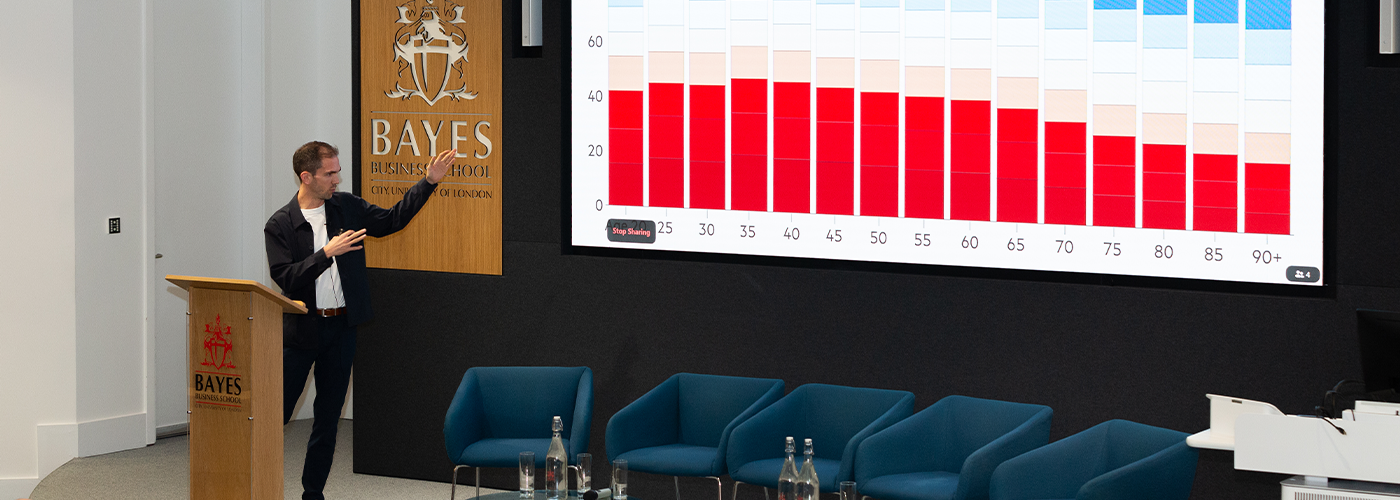
Nasty, brutish and short? FT journalist explores falling life expectancy for poor Britons
At an event to mark the 50th anniversary of our Faculty of Actuarial Science and Insurance, data journalist John Burn-Murdoch explored the causes of widening health inequalities in the UK and their far-reaching implications.
Bleak data revealing growing inequalities in British mortality rates were explored during an event to celebrate the 50th anniversary of Bayes' Faculty of Actuarial Science and Insurance last week.
The Financial Times' chief data reporter, John Burn-Murdoch, outlined the UK’s widening lifespan inequality – specifically amongst the 5 per cent of the population living in the most deprived communities. Lifestyle diseases, including obesity and substance misuse, and related cancers, are driving the trend, he said.
Noting that he had partly drawn on the work of Les Mayhew, Professor of Statistics at Bayes, who has worked extensively on data around health inequalities, morbidity and mortality, John said a higher proportion of deaths among young people occur in deprived areas. And while average UK life expectancy – and that of the top 10 per cent – remain broadly in line with international peers, the trend for the poorest Britons to live longer than their counterparts in comparator countries has gone into reverse over the last 30 years.

Above: John meets Professor Steven Haberman (left) while chatting with Head of Faculty Dr Russell Gerrard.
John said that in the mid-1990s the UK stood out for relatively impressive outcomes among its poorest citizens. Today, however, it holds the undesirable distinction of being the only developed country where the gap in lifespan inequality between the poorest and richest has widened over the past generation.
Progress on reducing deaths from 'lifestyle diseases' has stalled
“Thirty years ago, the UK's poorest were doing better in terms of life expectancy than their counterparts in other rich countries. Now, they’re doing significantly worse. Lifestyle conditions such as cardiovascular and liver diseases remain major killers for the poorest in Britain. While most developed countries have made steady progress in reducing deaths from these causes, the UK has stagnated."
“In every other developed country, the poorest 5 per cent have gained more years of life than the average over the past 30 years. The UK stands alone as the only country where this isn’t true.”
Similarly, Britain’s rate of improvement in cancer survival has slowed compared to other countries.
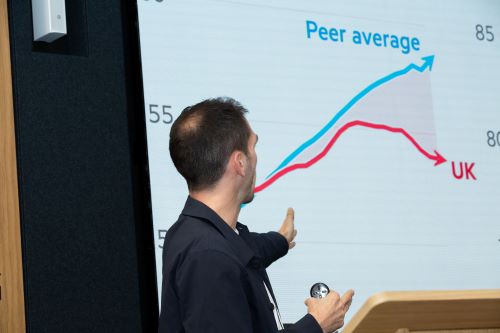
Above: John explains another bleak graph around thealth inequalities.
He explained: “It’s not just about people dying at higher rates. It’s that the rate of progress has been significantly slower here. Deaths related to drug use, violence, and self-harm have risen sharply."
Pointing to the surge in drug-related deaths, he said: “The UK has gone from being a relatively good performer in this area to significantly below par.”
Although austerity measures introduced in 2010 have been linked to worsening public health outcomes, John argued that this offers only a partial explanation.
“For the poorest 5 per cent, the decline started long before austerity – it’s been a generational issue.
“The UK’s struggles are not unique among Anglophone countries. Both the USA and Canada have experienced rising health inequalities, with life expectancy for the poorest stagnating or declining. However, other English-speaking nations – such as Australia and New Zealand – have bucked the trend, highlighting that such outcomes are not inevitable."
The findings raise questions about public health policy and societal priorities, he suggested. Experts point to a combination of individual behaviour, systemic healthcare shortcomings and socio-economic stressors as key drivers.

Above: John chats with Professor Les Mayhew (centre) and another guest before the panel discussion and lecture get underway.
John called for a rethinking of public health interventions, particularly for those at the bottom of the socioeconomic ladder.
“These aren’t necessarily problems that can be solved through conventional public health measures. Issues like drug deaths and violence require innovative approaches, including tackling supply-side factors like drug availability.”
Concluding on an upbeat note, he pointed to emerging solutions, such as advances in weight-loss drugs and declines in opioid-related deaths in the USA. Even entrenched health crises could be mitigated with targeted strategies, he said, while noting that Americans with a college education are currently the most frequent users of breakthrough weight loss drugs, such as Ozempic.
He added: “If we’re serious about addressing health inequality, we need to shift the focus from the average to the margins. Only by doing so can we hope to reverse these alarming trends and ensure that every Briton, regardless of their socioeconomic status, has the opportunity to live a long and healthy life.”