
From incubation to impact: new framework illustrates how industries are created
Research co-authored by Bayes Business School has developed a novel framework outlining the processes that lead to creation of new industries.
Nascent industries are new or developing industries at an experimental stage. Successful commercialisation can bring significant benefits of new products, jobs and social norms, with recent examples including driverless vehicles and eSports.
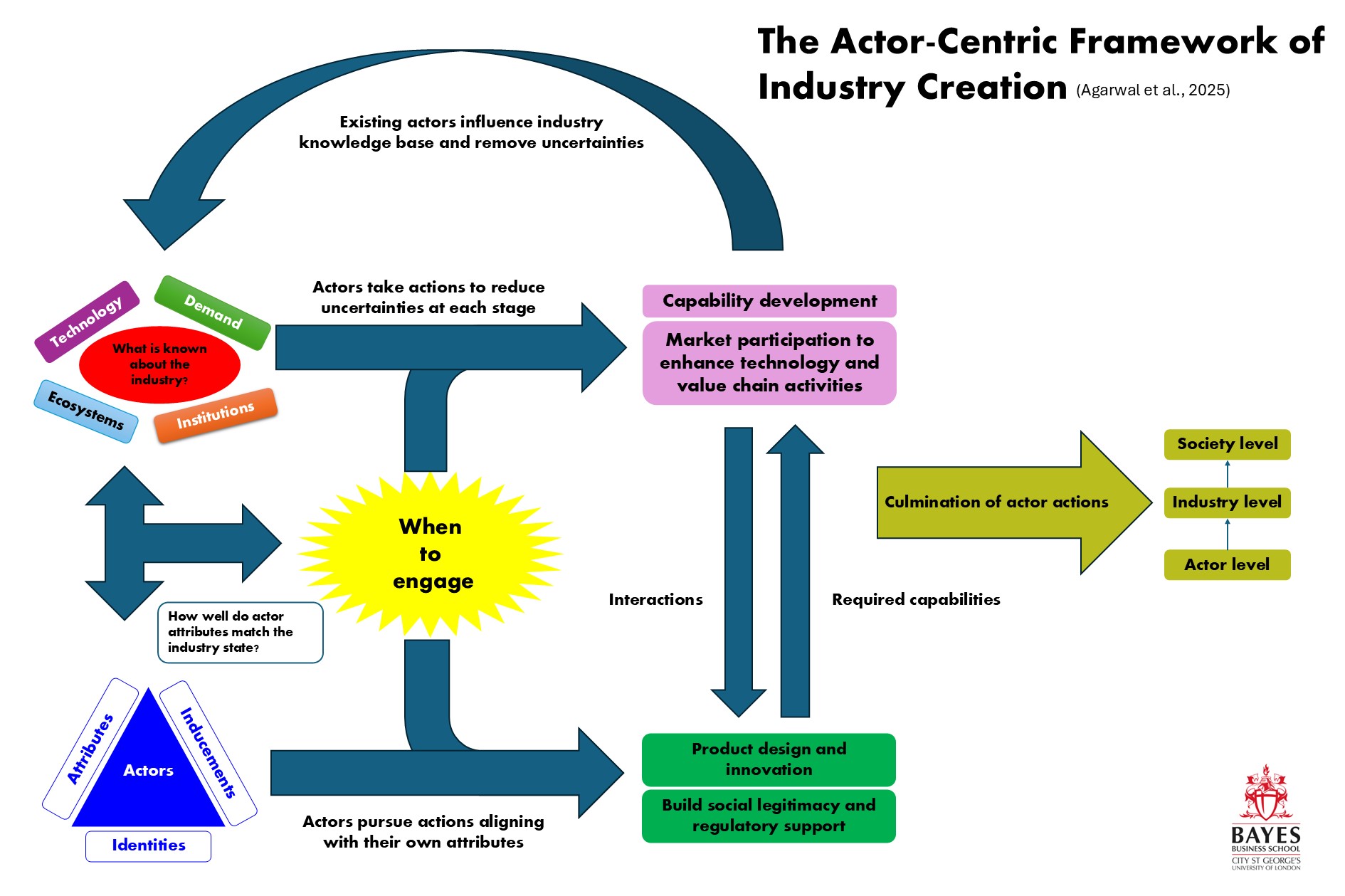
While new technologies and market needs are requirements of a nascent industry, the framework illustrates the importance of actors and their engagements, timing and mobilisation in removing pervasive uncertainties in pursuit of societal acceptance.
The comprehensive review of nascent industry literature was carried out by Dr Mara Guerra, Senior Lecturer in Strategy at Bayes, with Professor Rajshree Agarwal from the University of Maryland, Dr Mahka Moeen from the University of Wisconsin and Professor Paolo Aversa from King’s College London.
Who creates and drives nascent industries?
The framework outlines three key groups of actors who shape nascent industries:
- Firms include incumbents who serve focal customers in existing industries using different technologies, while diversifiers have technological capabilities but serve different customers and see new industries as opportunities for growth. Startups are created to serve the new industry.
- Non-firms include universities, user communities, industry associations, regulators and the media.
- Individuals include scientists and users with an unmet need. Mission champions and advocates also bring needs and benefits to public attention.
Each actor possesses a unique set of attributes and their own financial and non-financial motivations for engaging in nascent industries. Firms with resources and production capabilities may seek profits and market share, for example, while scientists may be induced by peer recognition and status.
Timing is everything
The timing of actor engagement is critical to new industry growth. Actors must weigh up four types of pervasive uncertainty – technological, demand, ecosystems and institutional – and how their unique capabilities can reduce them, when deciding to commit resources. The framework outlines four sequential stages of growth:
- Incubation is triggered when a discovery is made, or an unmet need surfaces. Earliest engagers typically include scientists, users and public agencies.
- The incubation stage invites early actors with technology and demand knowledge, such as scientific communities and early academic or user start-ups not seeking immediate financial reward.
- Pre-firm take-off occurs after the first commercialisation of the new product in an industry. Market exchanges attract regulators and media coverage, encouraging firms with financial inducements or those that can leverage existing value chains.
- In the pre-sales take-off, previously hesitant firms bring scaling capabilities, attracted by greater certainty of revenues. Employee entrepreneurs may also use acquired knowledge to create new startups.
Capability development
Once actors engage they must adapt their capabilities, by interacting in different markets to prosper and grow a nascent industry. Firms, for example, may invest in research and development (R&D), with or without universities and scientists, or create alliances to build new value chains and differentiate from competitors.
Actors also undertake market and non-market interactions to innovate product designs and features, as well as building societal legitimacy with an industry’s audience and regulatory support. These newly established norms, capabilities and regulations eventually provide the launchpad for an industry.
Dr Guerra said:
“The creation of new industries is important for the survival and success of firms, and overall development of society.
“Our framework acknowledges the importance of actor diversity and the dynamic interaction process behind industry creation, introducing the vital roles of actors beyond producers and the attributes they provide.
“The study has implications for all actors, including entrepreneurs, inventors and product champions, by outlining interactions and uncertainties that drive or hinder engagement.”
‘Creating new industries: the generative role of heterogeneous actors’, by Professor Rajshree Agarwal, Dr Mara Guerra, Dr Mahka Moeen and Professor Paolo Aversa is published in Academy of Management Annals.


