Exploring Social Discrimination in a Digital Era
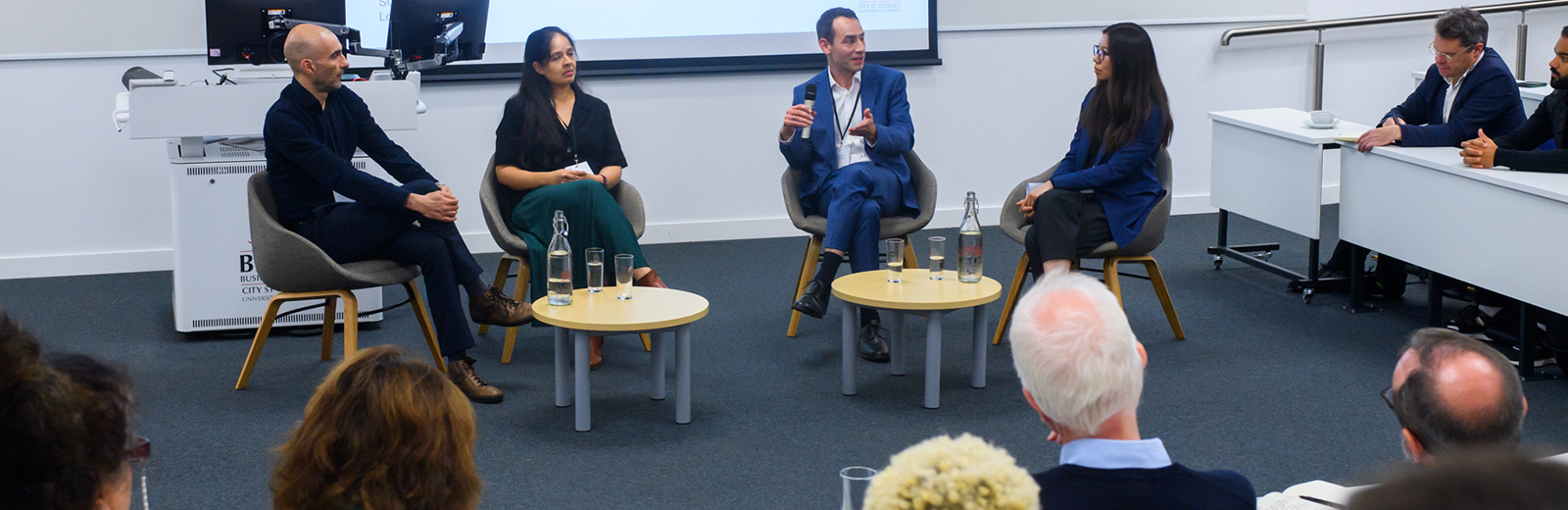
Artificial intelligence (AI) has the potential to be a lasting force for fairness, equality and prosperity, but risks causing further social polarisation if misused – according to panellists at this year’s Craft Lecture.
The annual event, established in 2021 following Bayes Business School’s name change, aims to explore themes of inequality and social justice. Speakers and audiences are encouraged to consider how society deals with the consequences of colonialism, while promoting engagement in initiatives towards a sustainable future.
The series celebrates the achievements of Ellen and William Craft, as representatives of those around the world who fought against the slave trade. Previous speakers include Alan Smith, First Church Estates Commissioner at The Church of England, Gurminder K Bhambra, Professor of Historical Sociology at the University of Sussex, and Clive Lewis MP.
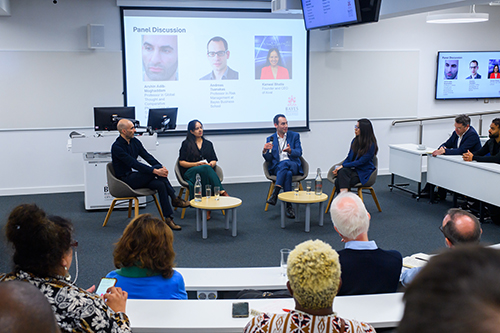
This year’s discussion focused on AI and its ability to enhance inclusion but also sharpen discrimination. Three expert panellists from academia and practice were on hand to offer views on how AI was being used to bring social equity their respective fields:
- Arshin Adib-Moghaddam, Professor in Global Thought and Comparative Philosophies at SOAS University of London
- Kanwal Bhatia, Founder of Aival
- Andreas Tsanakas, Professor in Risk Management at Bayes
“AI has expanded the breadths of both good and evil”
Panellists offered diverse perspectives on the impact and potential of AI in risk management, healthcare and geopolitical movements.
Kanwal, who founded Aival to help improve quality assurance of AI-assisted technologies in hospitals and medical practices, described how standardising quality of machine learning and bringing it to different parts of the world could drastically improve global healthcare and reduce inequality gaps. The main challenges, she explained, lay in the non-uniformity of data across markets and restrictions on monitoring data collection to confirm its reliability.
Professor Tsanakas, whose research focuses on discrimination in insurance pricing, spoke about the challenges of collecting, defining and measuring representative data, which can commonly be skewed by underrepresented characteristics.
As well as the challenges, both Kanwal and Professor Tsanakas spoke about the role of regulators and stakeholders in supporting or hindering the use of AI in assessing characteristics.
Professor Adib-Moghaddam joined the discussion to address downsides of AI in the spread of misinformation, fear-mongering and demonising sections of society for geopolitical gain.
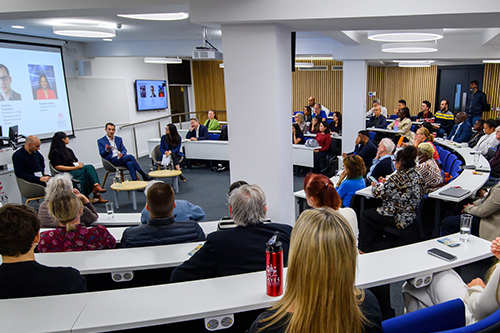
Following the discussion, members of the audience put a range of questions to the panel on the subjects of using AI to mitigate discrimination in the workplace, the future of job security, and the role of chatbots in recruitment and selection.
The event was moderated by Dr Joyce Liu, Senior Lecturer in Marketing at Bayes. Dr Liu said:
“The Craft Lecture is an important event in the Bayes calendar for reflecting on how social inequalities can be addressed.
“Artificial intelligence has tremendous potential to level the playing field and reduce biases and discrimination that continue to hold certain demographics back.
However, in order for this to work effectively, as our panel has emphasised, the data with which it is trained must be uniform and ethical, which is difficult to achieve across different countries, demographics and legislative frameworks.
“On the flip side, through manipulation and inaccuracies, AI can drive an even bigger wedge between social groups if it is trained with biases and misguided information.”
Read more about the Craft Lecture series at Bayes Business School.