The curious liberation of speaking out
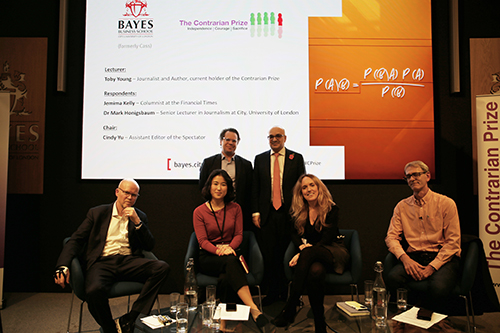
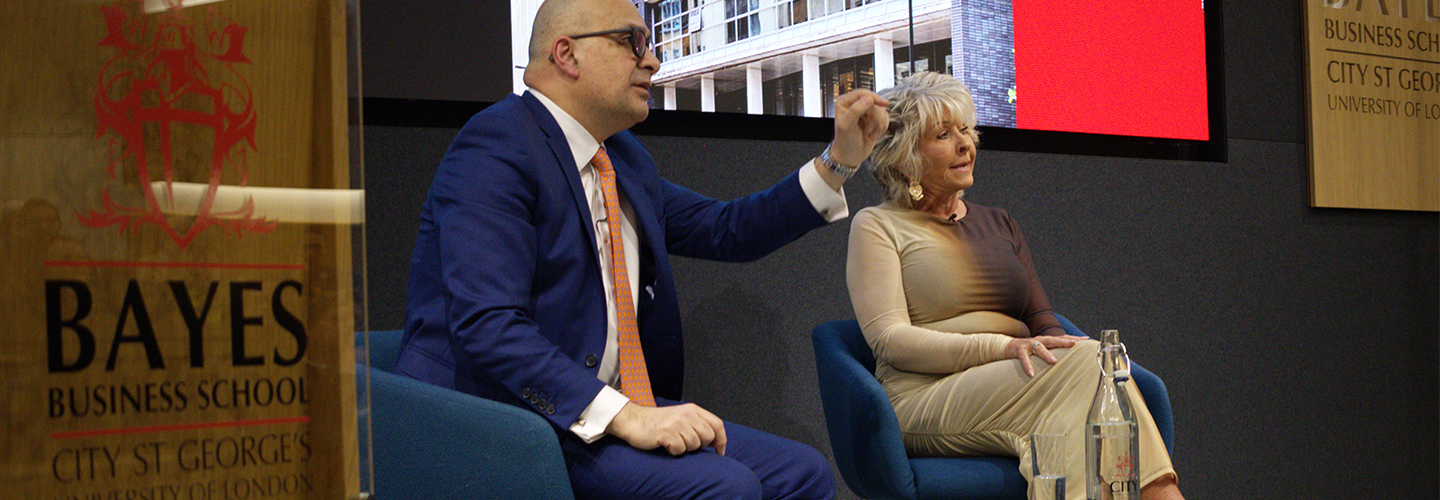
Bayes Business School hosted the 2025 Contrarian Prize Lecture this week. It was delivered by former detective Maggie Oliver who resigned from Greater Manchester Police over the handling of the grooming gangs investigations.
Maggie Oliver ‘stepped out of the gang that is the police’ rather than ‘be a good little girl’ over concerns about the force’s response to gangs grooming children for sexual exploitation, an audience at Bayes Business School heard this week.
Ms Oliver was delivering the annual Contrarian Lecture at the School, having been named as the 2025 Contrarian Award winner earlier this year. The award, which is decided by an external panel, recognised her courage in resigning from Greater Manchester Police (GMP) in 2012 in protest at the force’s handling of the grooming gangs investigations.
One investigation, Operation Augusta, was closed with no charges while Ms Oliver was on bereavement leave following her husband’s death. She resigned after challenging the GMP leadership over a decision to drop the testimony of a young woman from a trial triggered by a second investigation into organised sexual abuse involving men of Pakistani origin.
“This young woman was two years out of her abuse. I had gone to her. I had been tasked by the most senior officers in GMP with gaining the trust of victims amidst promises to me that there wouldn't be a repeat of Augusta. I had given them my word that if they put their trust in me, I would support them right through the system to court.”
Speaking truth to power
These events played out as the public learnt that South Yorkshire Police had repeatedly and systematically lied about the Hillsborough football disaster. The revelations only emerged after families of the 96 Liverpool fans who died had campaigned for decades.
Ms Oliver said: “Watching that story on the news, I didn’t want my children asking why I hadn’t told the truth (about the grooming gangs). I initially thought the problem was one lazy senior officer who told me senior officers make decisions and that if I couldn’t accept that then I was in the wrong job. The Chief Constable sent me a four line response after I submitted a file which was the size of War and Peace. It fell to me to decide to walk away or be a good little girl.”
In a meeting with another senior officer she was warned that going public with her concerns could see her charged with a criminal offence as police officers “effectively sign the Official Secrets Act”.
I didn't go into this to lose my job or to make money. I found myself in a position where to speak the truth. I had to leave my job, but I still don't know that there is any alternative. In the end, you're on your own if you speak out but you know you have to, you have to.
After reading out the oath all new police officers take, Ms Oliver said: “From day one I tried to do what I promised with the oath – to discharge all duties faithfully according to the law. However, as I often say, I never promised to do as I was told.”
Her decision to quit a job she loved had a big financial and emotional impact.
“It was a leap into the absolute unknown. I was a single parent. I lost my income, I lost my career, I lost my purpose. I was terrified where this road would lead. I lost my home. I ended up in a little apartment. I took in a lodger. I was living hand-to-mouth, but it was actually liberating. Speaking the truth is liberating, and I have never diverted from that.”
Introducing Ms Oliver, the award’s founder and chair, Ali Miraj, invoked the Nobel Prize-winning Polish Poet Czesław Miłosz, who said: “In a room where people unanimously maintain a conspiracy of silence, one word of truth sounds like a pistol shot.”
The Contrarian Prize, Mr Miraj said, recognises individuals active in British public life who have challenged the status quo and demonstrated independence of thought, shown courage and conviction in their actions, and made a sacrifice for their beliefs - all while "having an impact on the public discourse”.
The corporate world, Mr Miraj said, is not immune to the group think and suppression of dissenting voices that the award seeks to challenge.
Welcoming guests to Bayes, Executive Dean Professor Andre Spicer said that while the Contrarian lectures often address controversial topics, they are an important reminder of the important place of independent thinking and free enquiry.