Forecasting M&A in 2026: is there gold somewhere over the rainbow?
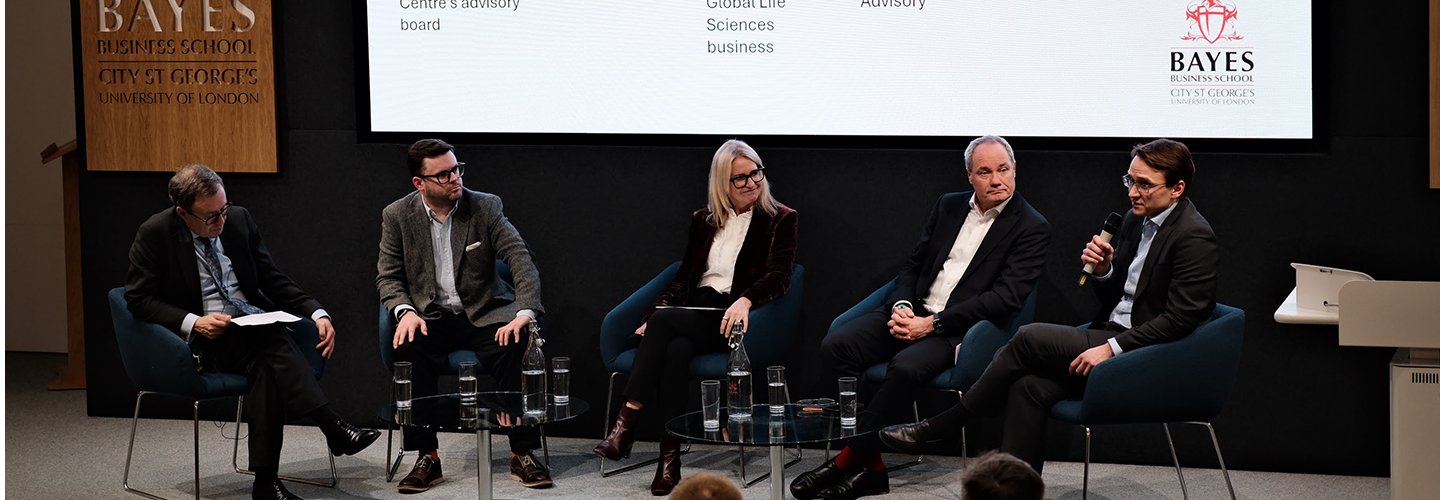
The bulls held sway on the big question at Bayes Business School’s recent annual market forecasting event: whether M&A activity would rise or fall in 2026.
Responding to the all-important final question of the evening, three panellists predicted the surge seen in the second half of 2025 would continue. Mergermarket’s Global Commentary Editor, John West, was more cautious, foreseeing activity holding at the elevated level it reached last year – “with risks to downside” amid geopolitical flux. Panel Chair Ian Hart, who also chairs the Bayes M&A Research Centre’s advisory board and previously led the Takeover Panel, predicted activity would be “flat with risks to upside”.
Mr West said: “Last year started slowly with people waiting to see the Trump administration’s approach – and then ‘Liberation Day’ in April delayed some deal timetables. After that we saw a flight to scale and a focus on supply chains. However, we also saw a new approach globally to antitrust regulation which, particularly in the US, meant pushing the envelope on the art of the possible.”
Noting that deals by value were up 50 per cent, he described 2025 as a “knockout year” – with boards seeking to “de-risk their corporate footprint”.
Keeping shocks in perspective
Mr Hart noted that the Liberation Day tariffs triggered “a remarkably short hiatus” in deals.
Liz Claydon, KPMG’s Global Head of Deal Advisory, suggested that the 79 megadeals (those above $10 billion) disguised a ‘flat’ year for dealmaking in terms of volume.
“The value of the top ten deals was more than double that in 2024. We are still seeing pretty eye-watering valuations – including with Netflix and Warner Brothers. KPMG’s global outlook survey of CEOs, published last month, was positive – with 89 per cent of CEOs expecting M&A to be a central or moderate part of their growth strategies.
“The private equity market is also definitely more buoyant than it was it in the first half of last year.”
Professor Michel Driessen, the new Director of Bayes’ M&A Research Centre, suggested the defence and tech sectors might drive a surge of activity in the opening half of 2026.
“I think we'll see more deals in the first half. Depending on certain geopolitical situations, sectors such as energy, construction, infrastructure and defence may get a significant push. The defence sector will get a huge boost, not only from the traditional manufacturing perspective, but also for companies involved in the technical and cyber security spheres – such as drones.
“Private equity is sitting on $2 trillion – that is 40 per cent of last year’s deal value. With everyone expecting interest rates to go down there should be more activity from PE.”
Mr West cautioned that tentative signs of asset allocation from the US to Europe would support consolidation this side of the pond in sectors such as energy and defence. The US fiscal deficit approaching 7 per cent of GDP at the wrong time in the economic cycle could restrict the number and size of interest rate cuts in the US, he added.
While President Donald Trump, perhaps inevitably, was an ever-present during the discussion, the panellists felt that reports of the death of ESG are greatly exaggerated.
Mr West said: “Watch out for the European Commission’s new merger control guidelines in the spring. They will have to balance classic consumer welfare concerns against the evident need for European champions to emerge, companies that can be globally competitive. As part of that, if you're going to convince the European Commission that two parties should merge where perhaps it might have been blocked on consumer welfare grounds in the past, you're going to need a damn good ESG story.
You’ll have to show why a deal would help Europe's defence, why it would create resilient energy sources or supply chains or how it can help European firms compete on the world stage. Although it might not be directly through that ESG prism, ESG overall is going to be a huge part of the stories that companies tell to get their deals through in the EU.
Ms Claydon agreed, saying that many US business leaders continue to identify sustainability as a lever of growth and something that needs to be embedded in their value chain.
“Every head of M&A, every CEO, every CFO I talk to is firm on that. A key PE client recently commented that every investment committee meeting kicks off with two key themes: the impact of AI and sustainability on the valuation and investment thesis. They are asking what AI and technology will do to either accelerate the growth of this business or potentially trigger its demise, and therefore, what's the impact on valuation? And they ask what sustainability means for their business, and how it is integrated in the supply chain and in capital flows.”
Professor Driessen, who is publishing a book on the financial upside of sustainability later this month, said: “We were a bit nervous when our publisher went quiet in January 2025 but the book is about creating financial value through sustainability – looking at it from a transactional perspective. We do that from a cost and equity perspective, but also from the de-risking of the evidence perspective.”
The event was introduced by Professor Scott Moeller, founder of the M&A Research Centre. It attracted more than 150 students, alumni and professionals.
Featured Bayes Experts
-

-
 Professor in the Practice of Finance, Director M&A Research Centre

