

"Now is the time for you to stop saying and start doing. Now is the time for you to play on!"
Dear graduates, congratulations! You have achieved something significant. Never forget it.
Dear friends and family of our graduates, you have also achieved something great by supporting the people who will cross the stage today. I’m sure our graduates will never forget the support you have given them.
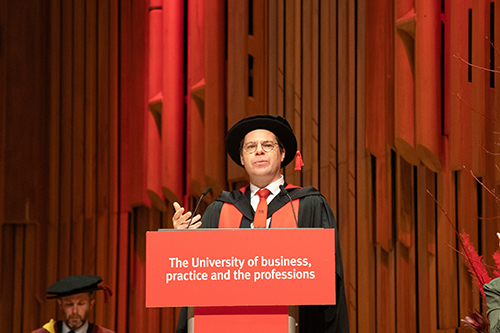
Recently I came across a quote which caught my attention:
‘When all is said and done, more is said than done’
In a room full of people who have spent years studying, analysing, debating and presenting, the quote might sting a little. You’ve spent years saying things, and a lot less time doing them. Today is the day all that talk stops and the doing begins.
That quote is from a man that almost all of you have never heard of. His names is Neale Daniher.
Daniher grew up on a sheep farm in rural New South Wales in Australia. He was one of eleven children. He went on to become a professional Australian Rules Footballer. He was a smart player with a brilliant football mind. After retiring as a player, Daniher became a coach of the Melbourne Football Club – one of the oldest and most important clubs in the world, and he mentored many great players.
In his mid-50s, when Daniher was at the hight of his powers, he was diagnosed with Motor Neurone Disease, or MND. It a disease with no cure, no effective treatement, and the average life expectancy from diagnosis is just 27 months. What is most cruel is that MND is often linked with sports like American football, soccer, rugby and Australian rules where players suffer frequent and repeated knocks to the head.
During his years as a player, Daniher took many of these knocks. Back then it was just part of the game, now it had become a fatal disease. What this meant is a game that had been Daniher’s life had also become linked with a deadly diagnosis.
When Daniher received his diagnosis, he was effectively told that his game was nearly done. But instead of leaving the field quietly, he decided to change the game. To use his personal motto, he chose to ‘play on’.
Rather than retreat, Daniher founded a movement called ‘Fight MND’. He also created what became known as the ‘big freeze’ – an annual event at the Melbourne Cricket Ground where, in front of an audience of over 100,000 people, sporting figures slid into a bath of ice to raise money for research on MND. Hundreds of thousands of people around Australia started buying and wearing Big Freeze beanies. He raised over 100 million Australian dollarsand has turned his own diagnosis into a movement.
Danhier passed away a few weeks ago, at home, surrounded by family. This was thirteen years after he was diagnosed with a disease which gave him, on average, two years to live. The mark of a person, his family said, is not what they said but what they did. Throughout his life he had gone from a farmers boy to a footie player to a coach to a national treasure.
When Danhier was a coach, young players would often come to him with their problems. One of his well known pieces of advice was this:
‘If you don’t like it, change it. If you can’t change it, change how you think about it’
This is not about passive acceptance. It’s not about resignation. It is one of this most demanding things a human being can do – to look at something and ask if it is in your control or not. If it is in your control, do something about it. If it is not, conciously choose to reframe how you see it.
Daniher couldn’t change his diagnosis but he could change what it mean for him and how he would shape his life in light of it. He made it into a platform, a purpose, a reason to act at a scale his career as a coach or player would never reached.
This is what resilience and ‘play on’ what actually looks like. Not gritting your teeth. Not enduring no matter what. Play on means being able to pivot with intention, with energy, and with others alongside you. Play on means finding another way to purpose your purpose. Play on sometimes means experimenting to find another purpose to live for.
Now, you probably aren’t facing motor neurone disease. But in your life, you will face things you don’t plan for. The job that doesn’t come through. The plan that looked perfect on paper, but collapsed on contact with reality. The personal loss. The instance of bad luck.
When things don’t go to plan – and they often won’t – ask yourself Daniher’s question. Can I change this? If the answer is yes, act. If the answer is no, change how you think about it and then act in a different way.
As a Bayes graduate, you are now part of an amazing alumni community. The person sitting next to you, the person you studied with at midnight before the deadline, the person who challenged your thinking during a seminar – they are your network. They are some of the people who will help you to play on. Invest in these people. Show up for each other. Be the person who helps your fellow graduate play on when they need some support.
During your studies, you have probably said enough. You have certainly heard enough from professors like me. You have also written enough in your exams and essays. And I’m sure you have presented enough during pitches.
Now is the time to remember Daniher’s words. Now is the time go out and there do something.
And when you have done it, which I know you will, come back and share with us what you have done. We will want to learn from you.
So, dear class of 2026, now is the time for you to stop saying and start doing. Now is the time for you to play on!
ENDS