
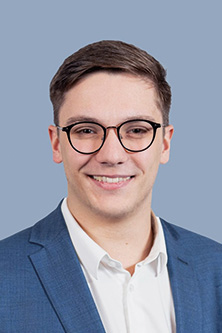
Eric Scheerbarth
Country of origin: German
MSc Course: MSc International Business
Graduation year: 2024
“I looked at all the big business schools in London, but it was Bayes that spoke to me.”
When Eric Scheerbarth was looking for a location for his master’s degree, his sights were firmly set on London:
“London was my focus because I had lived in the UK previously, and I wanted to get the city experience, rather than living in the countryside.”
“I was looking to extend my skillset to be able to break into management consulting, and felt the MSc International Business would help me get there.”
The MSc International Business helps professionals realise their ambitions to build a successful business career in a global setting. Ranked 2nd best in London, top ten in the UK and 41st globally (QS International Trade 2025 Ranking), the programme opens doors to leadership roles in areas including finance, strategy, marketing, operations and accounting.
“Before my master’s at Bayes I was purely a ‘tech guy’ – I did Business Information Systems for my undergraduate degree in Germany. With my master’s I was looking for a chance to break into the business world, and I liked the international perspective that the course offered. I was excited about consulting and the idea I could break into that. I figured an international perspective to business would really help me move in that direction.”
“The first thing that caught my attention about Bayes was the rankings, and the School had a very good academic reputation. I’d seen they had invested in facilities and that made me believe it would be a good all-round university to help build my future career.”
“I looked at all the big names in London, but it was the online presence of Bayes which spoke to me – I liked the teaching structure for the course, and how previous students described their experiences. It just felt like a good fit for me and where I was career-wise.”
“If you want to go into management consulting, the opportunities are endless, because you learn everything you need to know to get started in that field. If prospective employers see from your CV that you studied in London and did well, that automatically helps your career.”
Learning with real-world application
Eric recalls two modules which had an impact on his understanding of the subject, and the wider context in which it operates.
“The Economics core module in the first term was so interesting - my lecturer really made the content come to life. My other favourite module was Geopolitical Risk Management, an elective in the third term. Our lecturer, Dr Elizabeth Stephens gave us the opportunity for a lot of discussion about geopolitical views. Given the diversity of the cohort, there were lots of opinions. It really made me appreciate different backgrounds and the validity of different views.”
His Business Research Project was another academic highlight.
“I applied to a special research programme which Bayes carries out every year with the Bank of England and was selected to take part. I was analysing to what extent the surge in shipping costs during COVID affected UK businesses. Then I wrote a statistical model and analysed all sorts of papers under the supervision of a senior economist at the Bank - I really benefitted from the expertise and knowledge they shared.”
Eric also sought out the support of the Careers and Professional Development Team.
“At the start of the year, the Careers Team tells everybody to already start applying for jobs.”
“I used the one-to-one service from the Careers team because they help you get a sense of which positions you might be suitable for and orient your CV towards those. They help you match your expectations to the reality of a very competitive job market in London. They show you how to organise your job search and really get the best out of it that you can.”
Achieving the career switch
Today, Eric works as a Consultant at Senacor Technologies, in Bonn, Germany.
“Senacor is an IT business consultancy which specialises in end-to-end digital transformation projects, mostly in the banking, automotive and energy sectors. The work is a good mix of both my degrees – the technical knowledge from my undergraduate, with the business management side from my master’s at Bayes.”
“For my undergraduate degree in Germany I did dual studies. It’s not a concept that is as familiar in the UK, but it is a programme where you get the academic education and practical experience. I worked for Deutsche Telecom for three and a half years while studying my undergraduate degree. Then I did an internship with Senacor. Now I’m back there working full-time having got a distinction in my master’s at Bayes.”
The London experience
One of Eric’s main motivations for studying at Bayes was to experience life in the capital. It did not disappoint.
“London has a lot to offer, and I think whenever you're looking for something new to experience, you can find it. And you can do it alongside a new group of people who will grow to be close friends over the year. It is a great feature to have outside from your studies.”
Eric has kept in touch with his cohort:
“Graduation in January was a great chance to catch up with friends from the course and acknowledge what you have achieved. The ceremony was more exciting than I thought it would be because it’s very traditional with gowns and mortar boards – in Germany we typically don’t have the gowns and the celebratory drinks after the ceremony. I think the British way is much more appreciative to the graduates.”
Graduation was also an opportunity for Eric to plan future trips to see his classmates.
“Last December I was visiting a friend in Bangkok, Thailand, and I’ve got more destinations planned to visit other classmates: the US, India, China and Norway are all on the horizon.”
Skills for life
Eric reflects on the essential skills he gained from his time at Bayes:
“Everybody who has studied at a competitive business school knows that time is the rarest resource. It really taught me another level of time management, and prioritising tasks. Also, learning through an international lens made a real impact – given the diversity of students and faculty at Bayes. It’s an environment where you are respecting and learning about each other’s views. That’s an important skill that I use in daily life.”
For anyone thinking of studying at Bayes, Eric has some words of advice.
“Know what you are getting into because it can be a lot. Once you are at Bayes, remember to try and take advantage of all the opportunities you have, because it is easy to ignore them. Do as much as you can to experience everything that is on offer and all the support you can get.”
“But even though you have high aspirations and expectations, remember there are nice places other than the Library. Try to find a balance, not just for your mental health, but so you can get the maximum out of what you experience.”
“My time at Bayes taught me that pushing yourself outside your comfort zone is not just a saying and that you can achieve more than you thought you could. My objective was to stretch myself and see what is possible – it is a chance to find out much more about yourself in terms of work ethic and priorities in life.”