
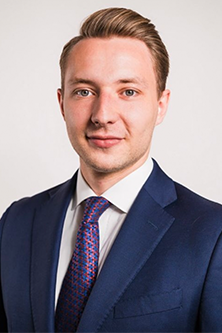
Lukas Baum
Nationality: German
MSc Course: MSc Real Estate Investment
Graduation year: 2022
“Completing my master’s at Bayes really helped drive my career forward.”
“In terms of Real Estate, London is undeniably the central hub for Europe, so it was definitely my preferred location.”
Lukas Baum is talking about his decision to take the MSc Real Estate Investment at Bayes, which develops analytical skills and practical expertise highly valued by employers.
“My first degree in Germany was a dual degree, which means I alternated time studying and working. That meant I never had the full student experience. I wanted to do a master’s to progress my career and decided to do it full-time.”
“Although I had some experience working in property development, my understanding was mostly practical, and I realised there was a much broader academic perspective and deeper reasoning that I hadn’t yet explored. I had been used to learning in a very practical manner from my undergraduate degree, and I wanted to stay close to the industry – which is what Bayes offers. So, the location was a draw, plus the programme itself, and because Bayes has a great reputation internationally.”
“The course gives you all the fundamentals and understanding of practical applications as well as a broader capital market perspective – how to do underwriting, how different cash flows look like and how they work etc. I mostly worked on the basis of underwriting templates in my previous job, but it was never explained why a certain cash flow item was in a particular position, what underlying factors drive certain assumptions, and what the bottom line really means for you, and how risk and return should be related. That was quite insightful – learning not only from the academics, but from my fellow students too.”
Building an international network
“You meet such a broad range of people on the course, from so many different backgrounds and countries. In our cohort we had people from the US, Canada, UK, Ireland, France, Greece and Italy, among others. Now, I’m confident that wherever I go in the world, I’ll have a friendly connection – someone I know and can reach out to.”
“There are so many opportunities to build your network at Bayes. From social events like the induction welcome party and Christmas drinks, to industry events and guest lectures. You form close bonds with your classmates studying late in the library, or going for dinner after lectures, and then you take those bonds out into the industry as you build your career.”
“I was active in the Real Estate Society, and we had multiple external speakers. They give you great industry insights – especially as I studied immediately post-Covid. There were a lot of structural changes in the industry at that time. Some could be explained by my professors looking at theoretical models, but it was also helpful to have industry people telling you how things had actually changed on the ground. A good example was the office market, and how home working was impacting real estate rents and yields. It gave an insight into how investors saw this asset class and where you could still find opportunities. These events were also useful for plotting my career path and where to position myself in the job market. It wouldn’t make sense to move into an asset class or subsector which was declining, so those events gave you the broader perspective of what was going on.”
Tailored careers support
“I had great support from the Careers Service. Coming from Germany, my CV was quite different – it ran to four pages and had a photo on it. The Careers Team helped me clean it up, and it had several rounds of review. It worked, because I secured multiple interviews and interviewers even positively commented on my CV. I held talks with numerous companies about potential roles, and there were multiple opportunities on the table. I went back to the Careers Service, and we brainstormed about what I could do. Should I go back to Germany, or stay in London? What job would have the best growth potential for me? Nobody has a crystal ball, but it was useful to have an objective second opinion from the team, in addition to advice from friends and family.”
After graduating Lukas secured a job as an Analyst at Goldman Sachs in London.
“If I hadn’t done my master’s at Bayes, I doubt I would have gotten the network and know-how, which got me my job at Goldman Sachs – that changed my career trajectory, because without my master’s I think it would have plateaued. Instead, it helped drive my career forward!”
From Goldman Sachs, Lukas moved back to Germany, becoming an Investment Analyst at Kadens Capital in Frankfurt. Kadens is a real estate private equity firm which also has offices in New York and Zug in Switzerland.
“I’m now working in real estate private equity, which means we are doing quite opportunistic deals in terms of structure and the real estate asset itself. I underwrite deals to Excel models and create presentations and fund pitches. It’s great because I am applying what I learnt on my master’s.”
“My company appreciates that I know so many people in the industry and can make introductions. I’d definitely say that my time at Bayes is facilitating the work that I do today. I’ve had multiple professional interactions with people from the course, working in other companies – in some instances that’s led to both Analysts bringing their Managing Directors together to speak. Sometimes a good collaboration or even a joint venture can come out of that.”
“It’s such a close-knit industry. For example, at the Expo Real fair in Munich each year – I probably see half of my friends from Bayes there, because everyone is going. You immediately have a rapport because you studied together.”
Lukas’s time at Bayes has given him the grounding needed to be able to work in multiple markets in different countries.
“I’d say London is a far more transparent market – you have more and better data, so studying in London is really helpful. The more data you have, the better you can understand how the market mechanics work. In Germany, you have different structural drivers - there is different regulation, some things move more slowly, some faster. But I think once you’ve understood the fundamental concepts and how they should work, you can apply the learning to multiple countries.”
Advice for prospective students
Lukas has advice for anyone considering a master’s in Real Estate at Bayes:
“It is a significant investment of time and money, so get everything you can from the year. Go to external events, speak to people in the industry, and really try and experience the city and what it offers. Build your network and make the effort to keep it alive after graduation. I see the master’s as an investment - it may take my first or second bonus to pay off, but if I hadn’t done the degree, I wouldn’t be getting the bonuses in the first place.”
“My time at Bayes has shown me that I am more comfortable with jumping in at the deep end than I thought. I would consider myself more of a stability-seeker, but looking at what I did – moving to a new country, finding accommodation, funding my degree, meeting new people – it was a lot more fun than I expected. I have tried to take that more adventurous and open-minded spirit with me in my professional and personal life.”
“Everything is related to real estate”
“I am excited for the future and what it holds. Whatever happens in terms of technology, demographics, even war – it’s all related to real estate. As technology develops, we’ll need more data centres. With a shifting demographic, we’ll need to build adapted senior housing. If there is a war, you need to rebuild communities.”
“Whatever trend you see, there will be a connection to real estate, you just have to make the best use of it. Even an astronaut needs starting facilities for their rocket, and somewhere to build it. When you think of it like this, it’s almost ridiculous how everything is related to the real estate industry.”