
Sebastian Veum
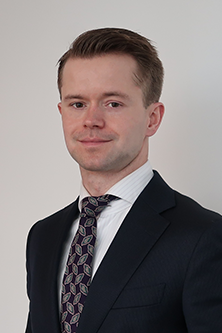
Nationality: Norwegian
MSc Course: MSc Finance
Graduation year: 2024
“The secret to a successful master’s at Bayes? Take up every opportunity and go all in”
“London is the European hub for finance, so I was well aware that this would be the best place for someone looking to get into the industry.”
Sebastian Veum is talking about his decision to relocate from Oslo, Norway to study MSc Finance at Bayes Business School.
“I had been accepted at several other leading London universities, but Bayes is well known in the Norwegian financial environment. It has a strong reputation and is regarded as being a challenge, which attracted me – it shouldn’t be easy. Having researched lots of different Finance-related postgraduate degrees, I found that the Bayes curriculum was more suited to my goals. I liked the balance of covering academic financial theory along with more quantitative and technical aspects. Some universities are highly quantitative, really focusing on modelling, but lack the business perspective. Others focus solely on business and lack the technical elements.”
“For me Bayes was the best blend - I can use my technical background in computer sciences, maths and coding, and combine that with new knowledge about finance and gain industry insight.”
Achieving a long-term goal
Sebastian already held bachelor’s degrees in Computer Science and Macroeconomics from the Norwegian University of Science and Technology, but he had a long-standing ambition to study in London.
“I decided in 2018 that I wanted to do my master’s in London and so I started to build up funds to make it to happen. I worked as a full stack software developer and also ran a small consulting firm with a friend where we did programming tasks for different companies. This was mostly to save up for my time in London. As well as deciding to come here for my postgrad, I set myself a goal of starting my career in one of the three largest investment banks in the world – JP Morgan, Goldman Sachs, or Morgan Stanley.”
“I’m now working at Morgan Stanley in Hungary, as a Quantitative Strategist Associate. It was my goal for seven years and I have achieved it, so now I am enjoying life and doing the best work I can.”
“I’m based in the Budapest office, which is their quantitative centre in Europe. In my role, I make algorithms that use our data to automatically create and forecast our risk exposure, in addition to summarising our hedging positions. I give the traders and salespeople what they need to help them make effective decisions, making sure we have optimised our risk exposure.”
“My role is hugely rewarding – it’s in my preferred ‘sweet spot’ of being a balance of technical skills and academic theory. As a desk strategist, you need to really understand the financial sector and how it operates, which is what my master’s at Bayes gave me. Plus, you need to be highly technical and really good at programming and maths. You need to quickly make the algorithms, and you can’t waste time trying to figure out how to make the code – it just needs to happen. Then you can focus on the accuracy and whether you have the right numbers and are providing everything the traders need.”
“The culture you are exposed to at Bayes prepares you very well for what’s to come in terms of working in a large firm – the high-performance culture and the fast pace. It made it a lot easier to fit in at Morgan Stanley, because I can just focus on the theoretical and practical parts of my job, and fitting into their working culture came quite naturally.”
Exceptional support from the Careers Service
The Careers Service played an important role in Sebastian’s career development.
“I had weekly meetings with Charlie Statham, MSc Careers Relationship Manager, and we still talk regularly. He gave me great insights about new opportunities, and what the market was doing – guiding me towards things I should apply for. We also looked at my CV and I got helpful feedback on it. At one stage I was unsure where I would best fit – such as on a trading desk, or in a purely quantitative role within Mergers & Acquisitions or Private Equity. The team helped point me in the right direction – it was actually Charlie who put me in touch with Morgan Stanley, so without him that might not have happened at all.”
“The team are all really helpful and they have created a comfortable environment – it’s not scary to go in and ask for help. Everyone should use it – after all, it’s part of the package of your degree and what you are paying for – it would be foolish not to use them. Another thing they taught me was how to reach out to companies in the right way – cold calling and cold emailing people. There is an art to doing it in a delicate manner, when hundreds of students are doing the same. The team helped me understand how to stand out in a crowded marketplace, and I was highly successful by following their advice.”
Sebastian also received invaluable careers support from Bayes academics.
“One of my professors, Professor Nick Motson, recommended me for an internship at a hedge fund and I secured that after one interview. It was a quant hedge fund focusing on commodity markets and it gave me great exposure to the buy side of the industry. It was a very competitive process open to candidates from many of the top-ranked universities in London.”
Making the most of the student experience
During his time at Bayes, Sebastian was President of the Bayes Trading Society.
“As President, I wanted to focus on building a community where people could connect and have a good time during their studies. That social aspect was important. We also brought in speakers from industry, to share insights and help students to network.”
“Being involved in a society develops lots of skills which are applicable to the workplace. Public speaking is the main one - I was already quite a confident speaker, which helped, because I would regularly need to take the microphone and speak to large groups of people. You also need to be a bit of a diplomat, solving disagreements, being inclusive and making sure everyone is heard and feels comfortable.”
Staying connected
Sebastian has stayed in touch with Bayes and will soon be giving a guest lecture.
“I want to help the next generation of students to achieve their goals like I did with mine. From a professional perspective, maintaining contact is an effective way to continue to nurture your network.”
“My talk will be looking at how we are utilising AI in the financial industry and how it will matter in the future. I want to motivate students and help them understand that if they don’t already have a grasp of coding and AI, it’s time to prepare.”
“I feel we are now at a tipping point in our industry where we are going to see huge changes in a short period of time. That is really exciting if you join the ride, but potentially frightening if you are not up to speed on the technology powering such seismic change.”
Advice for future students
For those thinking of following in his footsteps at Bayes, Sebastian has useful advice.
“Be yourself, get to know people and attend social events after lectures. That will help you build a strong network. Also, it is only one year, so do the very best you can. Take it seriously and go all in. Every module is valuable in some aspect. Take up every opportunity offered to you and say ‘yes’ to everything. Attend the many events which Bayes hosts. They will give you exposure to representatives from highly prestigious firms, from every sector – be it commodity trading, private equity, investment banking etc. It’s a great way to gain market insight and build a network of contacts in the industry.”
“Every aspect of your year will benefit you. And it extends beyond that year – as a Bayes alumnus you have life-long access to the building and facilities. You are part of the Bayes community forever, so use it.”
“From my time at Bayes, I’ve learned that I am able to achieve almost whatever I believe, so long as I am invested in the goal, and giving it everything. I managed to get a distinction in my master’s while juggling different jobs and responsibilities, without sacrificing the social aspect. And I achieved that because I decided to go for it and put the measures in place to make it happen.”
“You really can achieve a lot if you go for it.”