
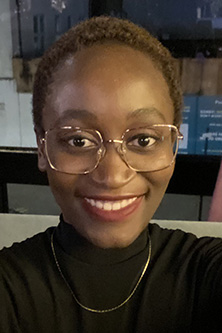
Sukoluhle Ndlovu
MSc Course: MSc Quantitative Finance
Graduation year: 2021
“The academics are passionate about what they do, and that passion overflowed into me”
“My master’s definitely helped get the job I have now. During the interview process the questions were very technical, but they were on subjects we had covered in the course.”
Sukoluhle Ndlovu recalls how the Bayes MSc Quantitative Finance helped her secure her current job as a data analyst for Mosaic Smart Data, which transforms transaction data into insights to drive revenue for Fixed Income, Currencies, and Commodities (FICC) markets.
The MSc Quantitative Finance opens the door to a career in asset management, or as a quantitative financial analyst. Suko’s first degree was in Civil Engineering, so the move into Quantitative Finance was something she worked hard to achieve.
“Part of the motivation for me to do my master’s was to learn more about the market itself and how instruments are priced. I already had experience with the data side as I was working as a software developer on the trading security side, but I wanted to have an overall deeper understanding of the market.”
“When researching my options, one of the recommendations was to do a quantitative course because it was technical, but also covered the mathematics behind the data. Looking at the programme Bayes offered, I could see that it tied in quite well. The course had a lot of foundational materials that I had never come across before. It would give me enough basic information, but also build on that with more advanced pricing calculations. It was a well-rounded course.”
“One of my teammates at work had gone to Bayes before and they recommended I go to an Open Day. I did that and I fell in love with the lecturers I met and the content of the course. I also got a scholarship to study, and so everything worked out well for me.”
Making the transition from Civil Engineering
“It was challenging because I come from a pure engineering background, so I am more familiar with the mechanical side of mathematics, not so much the statistical side. Going into the course, I only knew basic probability. But the good thing about the course is that they give you a foundation to bridge that gap.”
Before the programme begins, students are required to complete a series of online pre-study modules, on topics including Fundamentals of Python, Mathematics, Probability and Statistics.
“I did the pre-courses that they offered before the term starts, and I got a good understanding of the statistics that are used on the course. I had to do a lot more reading than someone who came from an economics or finance background, but I managed.”
Suko was aided by Bayes’ extensive resources which students can access.
“There are so many free resources – like financial newspapers, journals and scholastic articles available in the library. That access was very helpful to prepare for interviews and understanding what the market was like, and what people in the industry were talking about.”
Small class sizes and extensive networking opportunities
Suko also appreciated the amount of contact she was able to have with her tutors.
“It’s very easy to have a lot of contact with your lecturer because the class sizes are small, and that’s something you don’t usually have in bigger universities. You can easily ask questions, and they are keen to impart their knowledge. One question can lead to a whole explanation of different things and how they fit together. I found that really helpful, especially as I wasn’t coming from a finance background.”
“The academics are passionate about what they do, and their passion overflowed into me. And I'm very grateful for that because I'm at a place where now I can use that passion and knowledge in my job.”
“Another great thing about Bayes is that they have access to a lot of industry experts, and collaborations with lots of city-based banks and financial institutions. You can use those events as an opportunity to explore the industry and see what you want to do and where you might want to work.”
Applying the learning at work
For Suko, several of her modules stood out as highlights, and she has been able to use what she learnt on the master’s in her current role.
“I really enjoyed the Econometrics module - it fitted in well with my love for data and I hit it off with Professor Giovanni Urga who teaches it. The module requires you to understand how to take a package of data and be able to clean it and structure it in a way that you can analyse it and run it through the software to get insights out of it.”
“I also enjoyed the numerical analysis module too as that is quite a data-heavy module. I enjoyed seeing the software behind the calculations and understanding the basics of building up the trading models and how they work.”
“I have been able to apply a lot of what I was taught on derivatives, financial mathematics and numerical analysis. Understanding the trading strategies and the risk and how that is derived and calculated for different types of derivatives. I didn’t have that view until I started working on some of the assignments and projects.”
“Doing the master’s made me realise that I actually love data analytics, not so much software engineering. Then I moved into my current company where they deal with fixed income and commodities data analytics. We take the transactional data of banks, and we run our Machine Learning and AI algorithms on top of that.”
“Through doing the master’s I know what the data is supposed to look like – I can dig deep into the analytics and see where the numbers look wrong. I can then give better advice and support to our clients.”
Being part of an AI-powered future
“I enjoy what I’m doing now, and I definitely want to pursue it further. I think my future will see me leaning into what AI and Machine Learning can do for finance and how we can use that to enhance the data analytics space, because I think there is a lot more which can be done.”
“Previously it was about capturing the data and storing it in the right way and making platforms more efficient for trading. Now I think it’s how do we use our data to capture more business – where are the gaps for analytics to fill? With the background I have there’s so much more I can do within that space, and it’s just figuring out how to navigate that.”
“We’re using AI and Machine Learning but at a very small scale and I think there are more opportunities. There’s so much data when it comes to finance, and we’re just capturing a small part of that. It’s going to be very interesting to see how that evolves and how I can apply the knowledge that I have in the years ahead.”