
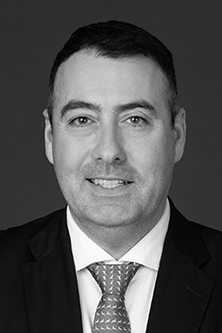
James Irvine
Transition: Function, Industry
Future-proofing myself with Bayes’ Global MBA
James Irvine shares his Global MBA journey and reflects how his time at Bayes gave him the academic theory to support his industry experience
My Global MBA Journey
My name is James Irvine, and I am Managing Director at Alvarez and Marsal in Riyadh, Saudi Arabia. I was looking for lots of things from my MBA. Mainly, I wanted to future-proof myself – I didn’t want to be the person who didn’t get the job because a business decided to select someone who did have an MBA. I also wanted to meet new people and to learn again – I had been out of formal education for almost 15 years, although I had done some industry-specific professional development.
I have been working in the Middle East for over a decade in the real estate and construction industry. I first came out in 2014, working on large-scale infrastructure projects in Qatar, which were being built to support the World Cup event in 2022. I then moved to Riyadh in Saudi Arabia in 2017, at a time when a lot of societal change was taking place. Saudi has a significant vision for 2030, and there is great opportunity – they have the largest population of the region and a really ambitious growth strategy. Saudi is probably the world’s biggest construction site right now, and that’s the industry I’ve been working in.
Choosing Bayes for my MBA
I had family members who had completed an MBA and said they had gotten so much from it. I first wanted to do the MBA when I came to Saudi, but I chose to focus on growing the business I was then working in, and really devote my time and focus to that. It was a success – it grew to over 10% of global turnover in seven years. But, as I was approaching 40, I thought if I don’t do this now, I’m never going to do it, so I started researching my options.
I looked at several highly ranked international business schools. I considered the FT rankings and went through many different options. Bayes has a really solid reputation, and once I knew I could do the Global MBA online, then I was really interested. While the teaching is online, you do get the chance to meet your lecturers and cohort in person. I came to London for the induction and integration weeks, and I also did some modules on campus in my second year.
When you go to the campus you really feel part of the School – I’ve been in the building, I shook hands with the lecturers, and you leave knowing that this is a quality establishment. Everyone at the School was friendly and helpful. It felt like a team environment, but with a little bit of healthy competition as well.
Returning to study after a long break
Having been out of formal education for a while, and coming from the construction industry, I did initially wonder whether I could hold my own. The first module was challenging, but it went well, and I got good scores. My results continued to steadily improve throughout the programme, and I ended up in the top 10% of the cohort.
Studying the MBA was hard work and took some adjustment. At weekends, I would get up as normal as if I was going to work during the week. I’d study from 8am-2pm and be very disciplined. Also, I was in a different time zone, but there were other students in all corners of the world – Canada, the UK, Australia – it was a really international cohort.
One of the best things about the Bayes programme is being able to select electives which you can tailor towards your interests and goals. I knew that Bayes scored highly for its expertise on entrepreneurship and strategy, and I was very interested in modules in those areas. I went on the international elective to San Francisco and visited a lot of venture capital companies with high turnovers, but I also saw the other side of the coin. We visited not-for-profit companies who are doing business for social good. It was really insightful to see that contrast.
Throughout my MBA, my family were very supportive, which was a great help, because it is a big part of your life for a couple of years - I remember family holidays where I’d be doing lectures from the hotel in Dubai. When I came to London for my graduation it was nice to bring them with me and make it a family affair. Graduation was the icing on the cake of my MBA experience, and it was good to catch up with old friends from the programme.
Changing career direction
I have recently moved sectors to work for a global professional services company, Alvarez and Marsal, who compete with the Big 4. Alvarez and Marsal have more than 10,000 employees in 40 countries, working in infrastructure, oil and gas, real estate, mining and energy, among other sectors. I’m working in their infrastructure and capital projects division providing construction advisory services.
Had I not done the Global MBA, I don’t know if I would have had the confidence to reach out to Alvarez and Marsal and seek out this new opportunity. Having got an interview, would I have approached it as strategically? Would I have presented as well? I definitely think doing the MBA facilitated the process and gave me confidence.
"The MBA validated my industry experience and gave me the best practice in terms of theory."
Continuing my relationship with the School
I’m currently doing an elective module on Artificial Intelligence – it’s one of the free modules that I get to take each year as an alumnus of the MBA programmes.
I very much want to remain connected to the School and I genuinely want to give back to other people. It’s part of the Bayes ethos – they encourage you to reach out and make new contacts, to help people and then reciprocate that when you can. The alumni community at the School is really strong.
I was recently a guest speaker on a panel event for the Global MBA, joining alumni from the UAE, and I was invited to provide a Saudi perspective. When I’m in London I try to go to the ‘Careers Beers’ events if the dates align – it’s always a good opportunity to make new connections with people who have shared the MBA experience and come from different industries.
Advice for prospective students
Be sure you really want to do it, because it is a lot of work. Pick modules which are outside of your comfort zone to get different perspectives on topics. Also, the support of your employers is invaluable – not necessarily in a monetary sense, but in terms of time. Although the course is online, there are times when you do go to London, so having an employer that will give you the time associated with that is important.
We were a very close cohort, and I really enjoyed the camaraderie. So don’t just turn up, do the work and be silent. Reach out to people – they will give you their time to make those valuable connections. Really embrace the fact that you are meeting people from all over the world and learning from some of the best academics in the business.