
Oliver Yogananthan

Transition: Function
“I am known as the Navy Officer who got his MBA in London”
While there is no such thing as a traditional route into an MBA, Oliver Yogananthan’s journey is definitely one less travelled.
“Before my MBA at Bayes, I was on active duty with the US Navy from 2014 to 2018. I was a Navy Supply Corps Officer, stationed both at the Pentagon, and on two US Navy warships.
“My role was to make sure that the ships had the supplies that they needed to execute their missions at sea. Later, when I did my high-level shore tours at both the Pentagon and at the headquarters of the Atlantic Fleet, I did a lot of funding and logistics analysis to determine overall requirements for the Fleet.”
So how did Oliver find himself in the heart of the City of London studying his Full-time MBA at Bayes Business School (formerly Cass).
A powerful foundation in business and leadership
“I already had a foundation in the operational side of navy logistics, but I wanted to zoom out and understand the strategic side. I was looking for an MBA programme which had a very strong business perspective, combined with international exposure. I felt that the Bayes programme was at the intersection of the two – being in London and specialising in corporate strategy. I felt it would give me what I needed to understand that bigger picture from a business perspective. That was a big attraction for me.”
Bayes’ Full-time MBA is built around four core modules that are designed to develop an understanding of how organisations function, and how to make strategic decisions. Modules combine the key areas of finance, leadership, strategy, operations, marketing and innovation.
For Oliver it was a curriculum with impact:
“The modules on Corporate Strategy taught me how organisations can remain competitive and sustain themselves on the global stage. Organisations can look inwards to understand their strengths and weaknesses, but at the end of the day, it’s what happens outside which affects profitability. Who are their competitors? How do geopolitical events play into it? Are there certain public sector policies to be cognizant of? The external environment can have such an impact on an organisation’s success and its bottom line. I still carry the learnings from those Corporate Strategy modules into my professional life.”
“The Mergers & Acquisition module was also impactful. The coursework focused on how do you make a deal, and do both organisations really understand the other side before they enter that deal? Especially when there is so much uncertainty going on – from within both organisations, but from the outside as well, hence the importance of compliance/due diligence. Another module which made an impact on me was managerial decision-making – especially the management of requirements and expectations across a diverse range of stakeholder groups. How do you make decisions in uncertain circumstances, and what’s the connection between your C-suite leadership and all the other stakeholders within the organisation?”
The MBA curriculum is also future-focused.
“The module on digital innovation inspired me to think about what AI and blockchains can do, and how these disruptive technologies reshape various industries. And that was long before AI was as ubiquitous as it is today. I would be remiss if I didn’t also discuss how international modules like the Dubai Symposium exemplified what was learnt in the classroom when it came to technology and business, especially the ecosystem created and scaled by the government of the UAE through successful public-private ventures.”
Gaining an international perspective
From living and working on US warships, to studying in one of the world’s most diverse cities, what did Oliver gain?
“The foremost thing I took from my time in London was perspective. When I wore the uniform on active duty, everything was very siloed. You only really know how the Navy does things and they tell you how to act. Coming to London, it’s such a diverse place and it’s a 24-7 culture. It gives you a perspective outside of a siloed mindset.”
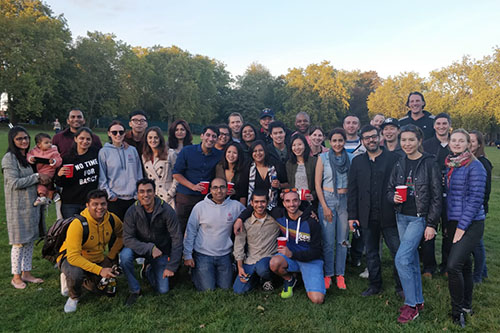
“I was blessed to study with colleagues from all over the world, and they helped me to navigate an international business culture and show me how to communicate differently. I was used to a very formal military-style of communication, and that doesn’t always work in a business setting.”
“The MBA helped me to understand that people are different and how sometimes our differences can become our strength. Coming from a regimented military environment, Bayes taught me how to work with different people and the viewpoints they bring. To understand that differences are rooted in culture, which as everyone in the MBA knows ‘eats strategy for breakfast’. Such culture can be at a personal, at an organisational level or a hybrid of both. Someone who works at HSBC in China would have a different outlook compared to someone who works at Amazon in the UK.”

“The MBA has really translated into what I do now. While the projects I work on are strictly classified, in my current role I act as a bridge or a synapse among stakeholders who speak very different professional languages - military operators, government officials, industry partners, engineers, and policymakers. These in turn span from the Pentagon, to various corporations domestically and abroad, and now even Capitol Hill in Washington DC. I’m there to coordinate between these groups to support mission accomplishment.”
“For my Business Integration Project (BIP), I combined my understanding of military logistics with digitisation and globalisation. It looked at how the defence logistics industry should respond to the disruption caused by e-commerce and the latest digital technologies. The central conclusion was that military logistics organisations need to transition from labour-intensive, highly siloed operating modules to ones that are more networked and data driven. To stay relevant in the 21st century, they need to leverage analytics and automation technologies. It built on themes that I had learned throughout the MBA, but specifically the strategy modules.”
“I believe my BIP helped me secure the roles I held after graduation, because I was able to talk to various important themes. These range from automation, analytics, digitisation, to logistics modernisation and have since become central to both industry and defence modernisation efforts.”
Tailored careers support and networking opportunities
“With my background, my resume was very niche and militarised. The Careers Team helped me to translate that into a more understandable civilian one. They also helped with networking events and making connections that have benefitted me later in my career. Later, when I was back in Washington DC after graduation, I was able to attend various defence networking nights, earning the reputation of the ‘former Officer who got his MBA in London’. This also helped me recently earn a reappointment to the Navy Reserves under their new Direct Appointment Program.”
“Doing the MBA in London really made my CV stand out. It’s a hook for a conversation. It is a global city; it’s the centre of international finance and a lot of other things. Hiring managers appreciate that I have a perspective that not every candidate does. Subsequently, I continue to serve both as a defence professional and as a U.S. Navy Reservist, giving me a unique perspective on how public and private sector organisations collaborate to support national security objectives.”
Advice to prospective MBA candidates
What words of wisdom would Oliver have for someone thinking of doing their MBA at Bayes?
“Embrace the diversity and perspectives of the cohort, because some of the most valuable lessons I learned came from my peers. The MBA is a great opportunity to broaden your perspective and is so much more than just having the credentials after your name. And for someone in a similar position, looking to leave Active Duty and pursue a civilian career, why not consider an MBA in a global city like London?”
“We live in very uncertain times but in my sector, I think we’re seeing a convergence of analytics, AI, strategy and defence modernisation. Defence is one of the least understood sectors by MBA students despite becoming one of the most strategically important sectors globally. As geopolitical competition increases, national security challenges increasingly depend on industrial capacity, supply chains, technology development, contracting, finance, and strategic resource allocation. Organisations need leaders within this unique ecosystem who can bridge the gap between government, industry, and innovation. That's where I believe MBA graduates can make a meaningful contribution.”