Foundation Year in Actuarial Science and Business Analytics

Key information
UCAS code: G32F
Duration: 1 year
Attendance mode: Full-time
Fees: £5760 (more information)
Location: Clerkenwell campus
Start of programme: September 2026
Application deadline: January 2026
Entry year: Showing course information for 2026
Gain a fundamental knowledge of mathematics, statistics, economics, and finance.
Overview
Foundation Year in Actuarial Science and Business Analytics Who is it for?
The Foundation Year is intended to provide a bridging role between pre-university study and the academic rigour of an undergraduate degree.
The Foundation Year gives you a fundamental knowledge of mathematics, statistics, economics, and finance to ensure that you are fully prepared to enter Programme Stage 1 of any of the Actuarial Science-related or the Business Analytics-related degrees at Bayes.
Course objectives
- Provide you with the mathematical skills that will be required for you to successfully engage with the modules in Stage 1 of your chosen degree.
- Introduce you to the concepts of statistical analysis that will underpin many of the modules you will meet in your main degree that focus on data analysis.
- Develop your mathematical skills to allow the manipulation of data presented in tabular or matrix form that you will meet in the main degree and your future employment.
- Develop your skills to enable you to tackle problems through an appreciation of cultural, political, economic and technological issues.
- Introduce you to both micro and macro economics ideas that shape the business world
- Provide you with introductory knowledge of finance and the implications to the problems that need to be solved by companies.
- Equip you with the ability to work and think both independently, as well as part of a team, in solving problems faced by the business community.
On successful completion of the Foundation Year you will have the essential mathematical skills that are needed to succeed on your chosen degree programme. In addition, you will have acquired an understanding of the key concepts and principles underlying the area of statistics, economics and finance, and the ability to identify and apply appropriate solutions when presented with a problem. On successful completion of Foundation Year you will be eligible for progression to Programme Stage 1 of your chosen main degree:
Teaching staff
Course director:

- Mr Michael Potten
- Mr Satjit Singh
Course content
You will study six core modules which will provide the necessary mathematical and statistical skills that you will need for your main degree while also introducing you to ideas in the financial and economic world where you will be applying your skills. You will develop your analytical and critical thinking skills which you can apply within the Foundation Year and your subsequent study.
Course structure
Modules
Compulsory Modules
Fundamentals of Finance
The work which actuaries, accountants and financial analysts carry out often involves determining a present value of a series of payments which are to be made in the future.
One of the aims of this module is to develop your understanding of how compound interest theory can be used to assess the value of investments and projects which are generating income and costs over an extended period of time.Fundamentals of Mathematics
This is a double module (i.e. there will be twice the content of a standard module with twice the contact hours) which will recap your maths A-level and start looking at some topics that are in the Further Maths A-level content.
Introduction to Probability and Statistics
This is a double module which will cover probability and statistics and is similar to the material covered in A-level statistics
Advanced Mathematics
This module will introduce concepts that are covered in the A-level further maths syllabus which are relevant to the material you will study on the main programme.
Fundamentals of Economics
This module is designed to equip you with the toolkit and give you the practice in applying this toolkit so that you can discover just how useful economics really is. At the outset, the module will introduce you to the central issues of scarcity and choice, and the extent of government involvement in decision-making.
Next, we outline economic reasoning and discuss how our understanding is advanced by the interaction between theories and practical application.Business London
The Business London module introduces you to the historic role of the City of London in the development of international business and finance. Some sessions will involve standard lectures, but for others you will be invited to walk around the City of London and to visit London institutions
Download course specification:
Foundation Year in Actuarial Science and Business Analytics [PDF]Assessment methods
Assessment is carried out according to context and purpose and recognises that you may exhibit different aptitudes in different forms of assessment. You will therefore be assessed in a variety of ways which allow development of a range of learning and teaching styles. These will prepare you for the assessments you will undertake on progressing to the degree programme.
Most modules are assessed by both coursework and an exam.
Coursework can include:
- Essays or reports which you can take home and complete with the aid of your notes.
- Class tests.
- Online quizzes and tests using the Virtual Learning Environment.
- Individual and group presentations.
- Group projects, sometimes based on case studies.
- An individual project, which is a piece of work where research skills are developed.
The format and timing of coursework varies considerably between different modules.
The term ‘formative assessment’ refers to assessment where you are expected to act on feedback and take it into account in subsequent coursework or exams. Some modules contain a considerable amount of formative assessment, where you will need to carry out coursework at various stages during the module. In such cases the coursework comprises a succession of separate activities. Where a module includes several components to the coursework this does not imply that you are expected to put more effort into the module than would be the case for a module with a single piece of coursework, but you will need to spread that effort across a term.
Formal unseen written exams take place at the end of each term (or at the end of the year, if a module is taught over both terms).
Assessment methods


Overall workload
Most contact hours take the form of lectures but with additional tutorials to help develop understanding.
Foundation workload
Study type
Term dates
Academic year
For a full breakdown of the current and forthcoming academic year view our term dates page.

Careers
This year is a foundation year that allows progression onto any of the actuarial science and business analytics degrees. For more information on Actuarial Science and Business Analytics related careers after graduation please see:
Alumni stories
Placements
This is an option on the following degrees which you can progress upon successful completion of the Foundation year.
Study abroad
Bayes Business School gives you the opportunity to spend a term or a year studying abroad at one of our partner institutions, which are located around the world in Australia, Europe, Asia and the Americas.
*Please note that the partner universities available is dependent on the study abroad programme you apply for and on your degree. The list of partner universities is also subject to change.
Asia and Australasia
Australia
-
Queensland University of Technology
Located in the bustling city of Brisbane, QUT was the first Australian university to gain 'triple crown' accreditation (EQUIS, AMBA and AACSB).
-
University of Queensland
Located in the popular Australian city of Brisbane, the University of Queensland features in the top 100 of 3 of the major rankings (QS, THE and ARWU).
-
University of Sydney
As Australia’s first university, the University of Sydney has an excellent long-standing reputation and is also ranked best student experience in Australia.
-
RMIT University
Giving you the chance to study in Melbourne, Australia's 2nd largest city, RMIT is one of Australia's original educational institutions. Their well-established business school allows students to choose from a wide-range of subjects.
China
-
Renmin University of China
Located in Beijing, Renmin Business School is both EQUIS and AACSB accredited. Their MBA programme is ranked in the top 50 in the world by the Financial Times.
-
Shanghai Jiao Tong University
You will take classes from the Antai College of Economics and Management, which was the first business school in mainland China to have been triply accredited by AACSB, EQUIS and AMBA. They have Bachelor programmes in Economics and Finance.
Hong Kong
-
Chinese University of Hong Kong
CUHK was ranked the most innovative university in Hong Kong in 2016 (Reuters). The 137 hectare campus overlooking Tolo Harbour houses a range of facilities such as world-class libraries, art museums, music halls, a swimming pool, sports fields, tennis courts, squash courts, a water sports centre and gymnasiums.
-
University of Hong Kong
HKU is consistently ranked in the top 50 world universities (Times Higher Education World University Rankings). You will be studying at their Faculty of Business and Economics.
-
Hong Kong University of Science & Technology
HKUST is ranked 4th in the QS Asian University Rankings 2016. HKUST Business School was the first school in Asia to be awarded dual accreditation by AACSB and EQUIS. It offers 11 undergraduate business programmes.
Singapore
-
National University of Singapore
NUS is ranked 1st in the QS Asian University Rankings 2016 and is one of the top 25 world ranked universities (Times Higher Education World University Rankings). More than 1,000 exchange students visit NUS each year.
-
Nanyang Technological University
Nanyang is ranked 54th in the Times Higher Education's World University Rankings. You will have the chance to study at one of Asia's most prestigious universities in the heart of Singapore.
-
Singapore Management University
SMU was founded in 2000 by the government of Singapore, modelling itself on an American style university structure. SMU has over 180 exchange partner universities around the world.
South Korea
-
Seoul National University
SNU was founded in 1946 as the first national university of Korea. SNU Business School was also the first business school in Korea to be certified by the Associate to Advanced Collegiate Schools of Business (AACSB).
Vietnam
-
RMIT Vietnam Campus
Living and studying at RMIT Saigon South campus in Ho Chi Minh City will give you great opportunities to get immersed into a dynamic, multicultural and intriguing city.
Europe
Austria
-
Vienna University of Economics and Business
WU has triple accreditation, one of only two German-speaking universities belonging to this group. They have a well-established exchange programme, with around 240 partner universities around the world.
Denmark
-
Copenhagen Business School
Copenhagen Business School often abbreviated and referred to as CBS, is a public university situated in Copenhagen. It is considered one of the most prestigious business schools in Western Europe and the world. CBS has been engaged in student mobility for decades and has a large number of partner universities all over the world. They send over 1,100 students to study at partner universities every year
France
-
ESCP Europe, Paris campus
Like Bayes, ESCP is triple accredited (EQUIS, AMBA and AACSB). The Paris campus is located in the centre of the city. The Masters in Management, from which you will take classes, is currently ranked 4th in the Financial Times rankings (2016).
-
ESSEC Business School
Established in 1907, ESSEC is one of the leading institutions in Europe for business education. Their BBA was the first programme in France to receive the prestigious AACSB and EQUIS accreditations.
Germany
-
Technische Universität München
TU Munich was named as the number one university in Germany in the QS World University Ranking 2016.
-
University of Mannheim
The University of Mannheim Business School is highly ranked and has an excellent reputation. You will be studying modules from their Bachelor degrees in Business Administration and Business Education in either German or English.
Italy
-
Bocconi University
Based in Milan, Bocconi is a triple accredited school (EQUIS, AMBA and AACSB) and is ranked 6th in the Financial Times European Business Schools Ranking 2016.
-
LUISS Guido Carli
LUISS Guido Carli is a private Italian university located in the heart of Rome. They are currently EQUIS and AMBA accredited and Luiss was actually the first Italian institution to have all its management programs accredited by EQUIS back in 2015, from the bachelor's degree program to the Master in Business Administration, as well as additional master's, specialization, doctoral, and business training programs. We are also currently ranked 59th in the QS ranking for Business and Management and our Master in Management is ranked 1st by the Financial Times based on career progress.
Norway
-
BI Norwegian School of Management
BI is the only Norwegian university with triple accreditation and has student exchange agreements with more than 200 institutions in 45 different countries.
Spain
-
ESADE Business School
The school is located in Europe’s most international city and Spain’s second largest city, Barcelona. Like Bayes, ESADE is triple accredited (EQUIS, AMBA and AACSB).
-
IE Business School
Situated in the heart of Madrid's financial district, IE Business School is ranked 1st in Spain and 5th in Europe (FT European Business School rankings 2015).
The Netherlands
-
Rotterdam School of Management, Erasmus University
RSM is consistently ranked in the top 10 business schools in Europe and has 'triple crown' accreditation (AACSB, AMBA and EQUIS). You will study all modules in English.
The Americas
Argentina
-
Universidad Argentina de la Empresa
Located in the heart of Buenos Aires, UADE has exchange agreements with 40 partner universities around the world. You will take modules from the undergraduate Global Management degree.
Canada
-
HEC Montreal
Like Bayes, HEC Montreal is triple accredited (EQUIS, AMBA and AACSB) and was the first school in North America to achieve this. There are opportunities to study in French or English.
-
Smith School of Business - Queen's University
Queen's Smith School of Business has a rich history dating back to 1841 and is consistently ranked as one of Canada's leading universities. It welcomes over 300 exchange students every year from more than 40 countries.
-
Ivey Business School, Western University
Ranked in the top 100 for Financial Times MBA Rankings, Ivey School of Business provides a competitive combination of world-class teaching and modern facilities.
-
Sauder School of Business, University of British Columbia
UBC is one of Canada's leading research universities and is consistently ranked in the top 40 of the world. Located 30 minutes from the heart of down-town Vancouver it attracts students from more than 140 countries world-wide.
-
University of Waterloo
For 19 years in a row, Waterloo has been named Canada's most innovative university in the Maclean's annual university reputational rankings. The Department of Statistics and Actuarial Science at Waterloo is among the top academic units for statistical and actuarial science in the world and is home to over 900 undergraduate students.
Chile
-
Universidad de Chile
Based in the cultural city of Santiago, the Universidad de Chile is one of only 10 Latin American universities ranked among the world’s top 500. It is ranked 6th in the QS Latin American Ranking 2016.
USA
-
Emory University, Atlanta
Located near downtown Atlanta, Emory University Goizueta Business School's BBA programme is currently ranked No. 15 by both Bloomberg BusinessWeek and U.S. News & World Report.
-
Ross School of Business, University of Michigan
The Ross School of Business has one of the top undergraduate business programmes in the USA, ranked #4 (US News & World Report, 2016). You will take modules from their Bachelor in Business Administration.
-
Robert H. Smith School of Business, University of Maryland
Located in College Park, eight miles from The White House and downtown Washington, D.C. you will be studying at the Robert H. Smith School of Business whose undergraduate programme was ranked number 19 in the USA (2016 U.S. News & World Report).
-
McCombs School of Business, University of Texas at Austin
One of the largest business schools in the US, McCombs is ranked the 6th undergraduate business programme in the 2017 US News and World Reporting Ranking.
-
McIntire School of Commerce, University of Virginia
The McIntire School of Commerce is regarded as one of the best business schools in America. Their UG programme is #5 in the USA (Bloomberg Business Week, 2016). They are partnered with a select number of business schools around the world, with Bayes being one of them.
Fees & funding
UK/Home fee
Tuition fee for September 2026
-
BSc tuition fee:
£5760
The Foundation Programme is for home fee paying students only.
Use a currency calculator to Convert to your local currency.
* Tuition fees are subject to annual change.
Tuition fee increases
The foundation year is a one year programme. On passing the foundation year, students will progress onto the main degrees where the fees will increase. Details on these fees can be found on the main course pages.
Scholarships & bursaries
Entry requirements
The Foundation Programme is for home fee paying students only. If you think you may still be eligible based on your circumstances, for example you have EU Settlement/Pre-Settlement Status, Indefinite Leave to Remain or Refugee Status, please email bayesug@citystgeorges.ac.uk.
If you are an international student please refer to City St George’s International Study Centre for information about the International Foundation Programme.
Standard home offer
-
A LevelB (Maths) BBGCSE English Language or English Literature grade 4 (C)
-
International Baccalaureate (IB)30 pointsoverall with minimum 5 in Higher Level Maths and either Higher Level 4 or Standard Level 5 in English.
-
BTEC/CTECDDplus A Level Maths (B). We also accept combination qualifications of BTEC/CTEC grade Distinction plus A Level Maths (grade B) plus another A Level grade B.
UK qualifications
A-Level: B (Maths) BB
We accept all foreign language A Level subjects, and such subjects are considered for entry even if it is the applicant’s native language.
If you are studying General Studies or Critical Thinking these subjects will not be included in any offer condition.
For A-Level applicants we also require a minimum of grade 4 (C) inGCSE English Language or English Literature.
IB: 30 points overall with 5 in Higher Level Maths (either Maths Analysis & Approaches or Maths Applications & Interpretation) and English at either Higher Level 4 or Standard Level 5.
International Baccalaureate Career-Related Programme – We welcome IBCP applicants on a case-by-case basis.
English language requirements
English language requirements
If your first language is not English, we will require evidence of English language proficiency. Minimum requirements are:
- GCSE: Grade C or 4
- IGCSE: Grade C
- O-Level: Grade C
- TOEFL (Test centre or iBT Special Home Edition): 92 overall (24 Writing, 23 Reading, 22 Speaking, 21 Listening)
- A-Level: Grade C
- Language Cert International ESOL: Language Cert B2 Communicator High Pass
- IELTS (Academic, UKVI or IELTS Indicator): 6.5 overall with no less than 6.0 in any sub test
- IELTS One Skill Retake: Must be taken within 60 days of previous IELTS test. Accepted for one sub test where all other components and the overall score have been met
- Pearson Test of English (PTE) Academic: 59 overall with minimum of 59 in each sub test
- International Baccalaureate: Grade 5 at Standard level or Grade 4 at Higher level
- Cambridge English Advanced (also known as Certificate in Advanced English): Grade C (180 overall) at CEFR Level C1 with minimum 170 in each sub test
- Cambridge English Proficiency (also known as Certificate of Proficiency in English): Pass qualification (all grades accepted)
- Cambridge English First (also known as Certificate of First in English): Grade A (180-190) at CEFR Level C1
- Vitnemal: English grade 5
- French Baccalaureat: 14/20 in English
- Malaysian GCE O Level (SPM-1119 syllabus only): grade A
Student life
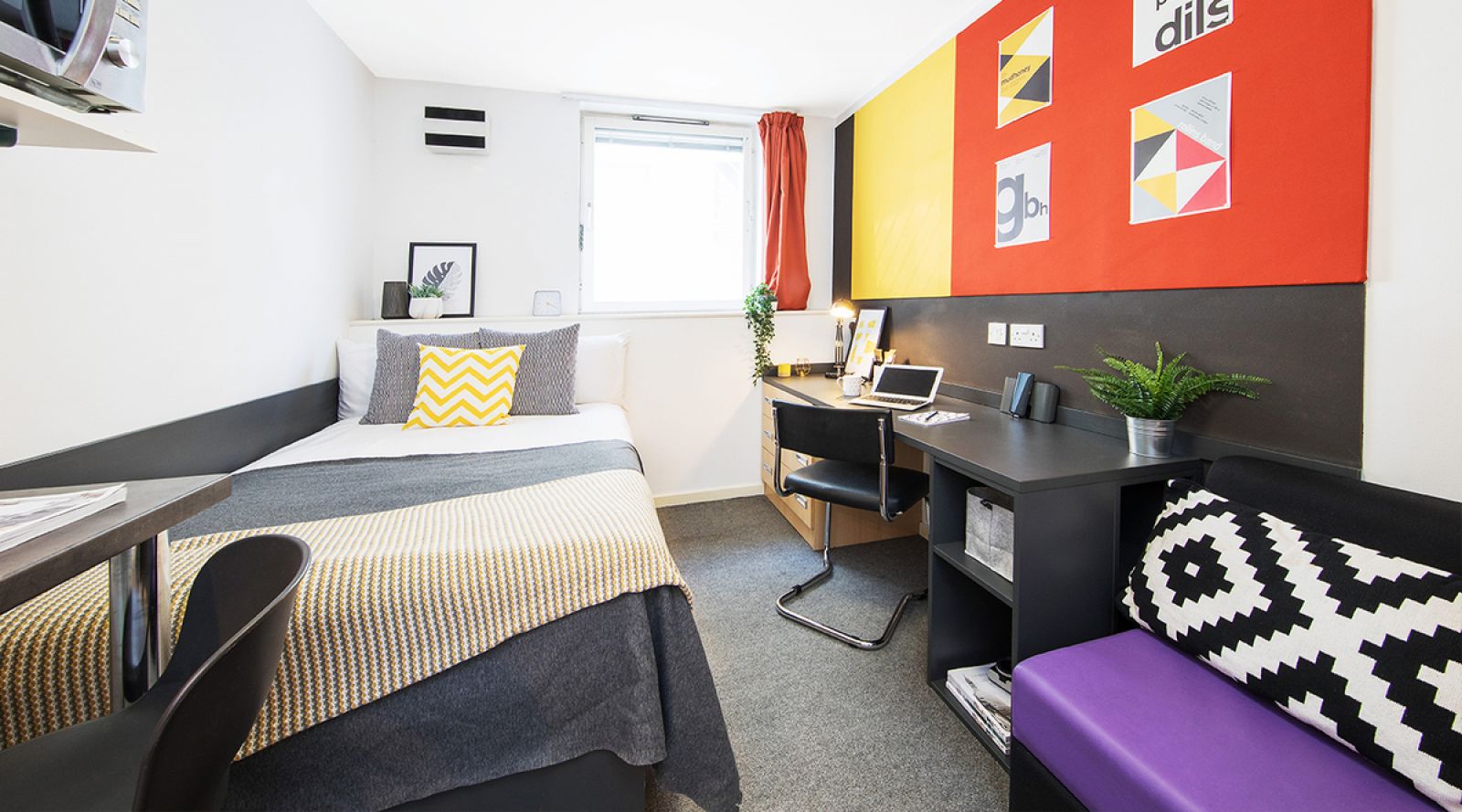
Study at Bayes and take advantage of all that London has to offer - from entertainment and nightlife to West End theatres, museums and world-famous shopping districts and markets.
See our Undergraduate Student Life page for further information.



-
Have a question about student experience at Bayes?
Talk one-on-one with a student who is currently studying at Bayes.
Apply
All applications should be made through UCAS, the Universities and Colleges Admissions Service. Applications are made via Apply, UCAS's online application system.
Terms and conditions
Students applying to study at Bayes Business School are subject to City St George's, University of London's terms and conditions.
More information about applying to BayesApply via UCAS
- Institution code: C60 (Bayes Business School and City St George's, University of London)
- Course code: G32F (BSc Actuarial Science and Business Analytics Foundation)
You can find more information at UCAS and in the UCAS Handbook.
Contact us
Speak to one of our staff from UG's programmes teams.