Conference explores mutually assured prosperity
A senior Bank of England official addressed a workshop on financial mutuals at Bayes Business School this week, shortly before today’s publication of a blueprint for regulation of the sector.
Laura Wallis, who is Director of UK Deposit Takers at the Bank, was speaking at the 6th Workshop on the Future of Financial Mutuals. The event, attended by academics and practitioners, is organised by Bayes’ Centre for Banking Research, in partnership with the Building Societies Association and Federcasse-BCC Credito Cooperativo.
Ms Wallis emphasised that the co-authors of today’s report, the Bank’s Prudential Regulation Authority and the Financial Conduct Authority, will continue to apply a proportionate approach to regulation of mutuals.
We are often asked if regulators would like to see more consolidation in the mutual sector. While we stand ready to support mutuals that wish to do this, from a regulatory perspective we are agnostic on this issue. We are committed to doing our part to make sure the regulatory cost of doing business is proportionate, especially for smaller firms.
She continued: "We are streamlining the senior manager and certification regime and have consulted on removing the building society source book to allow them to compete on a level playing field with banks and have removed regulatory fees for a swathe of smaller firms.”
Recent reforms - such as the ‘strong and simple regime’ for banks and building societies and updates to Solvency II for insurers - will reduce regulatory burdens and support sustainable growth, she said. Some 97 per cent of eligible building societies, Ms Wallis said, have already benefitted from simplified liquidity requirements and new solvency rules.
She outlined five broad challenges facing mutuals, on top of the intense competition and technological change that confront all financial services firms.
These are:
- Limited new entries: only seven new credit unions have been registered since 2015, while the last mutual insurer to write new business for consumers was authorised in 1988 - seven years after the last building society authorisation
- Sustainable business models: most mutuals do not enjoy economies of scale and are committed to retaining a branch in communities they serve
- Access to specialist staff and experience – particularly when many rely on volunteers
- Access to capital which, while an issue for most firms, can be particularly acute for mutuals – given their mutual ownership structure and limited external options
- Exiting the market through closure or merger.
On the latter she said: “In a well-functioning and dynamic market there is a need for viable firms to leave with minimal disruption. For banks, building societies and insurers, we have published supervisory statements around preparing for orderly, solvent exits. We also ask the largest credit unions to prepare credible, solvent wind-down plans. The aim of this policy is to ensure firms can, if necessary, cease regulated activities responsibly and without market disruption. These regulatory expectations are proportionate to firms’ size and complexity.”
Bayes Deputy Dean and Director of the Centre for Banking Research, Professor Barbara Casu, said: “Mutual and cooperative financial institutions are vital pillars of local economies, but they face profound challenges as technology, regulation and market structures evolve. We welcomed Ms Wallis’s speech at our workshop, which brought together researchers, policymakers and industry leaders to examine how these organisations can remain resilient, competitive and inclusive in a rapidly changing financial landscape.”
An upbeat mood
Industry leaders visiting Bayes for the event also welcomed the direction of travel suggested by Ms Wallis’s presentation.
Robin Fieth, CEO of the Building Societies Association, described her contribution as “positive and forward looking”.
Andrew Whyte, CEO of the Association of Financial Mutuals, said regulators appear to recognise mutuals as drivers of growth.
Matt Bland, CEO of the Association of British Credit Unions, welcomed the apparent ‘direction of travel’, saying regulators appear to recognise the scale of the challenges around financial inclusion.
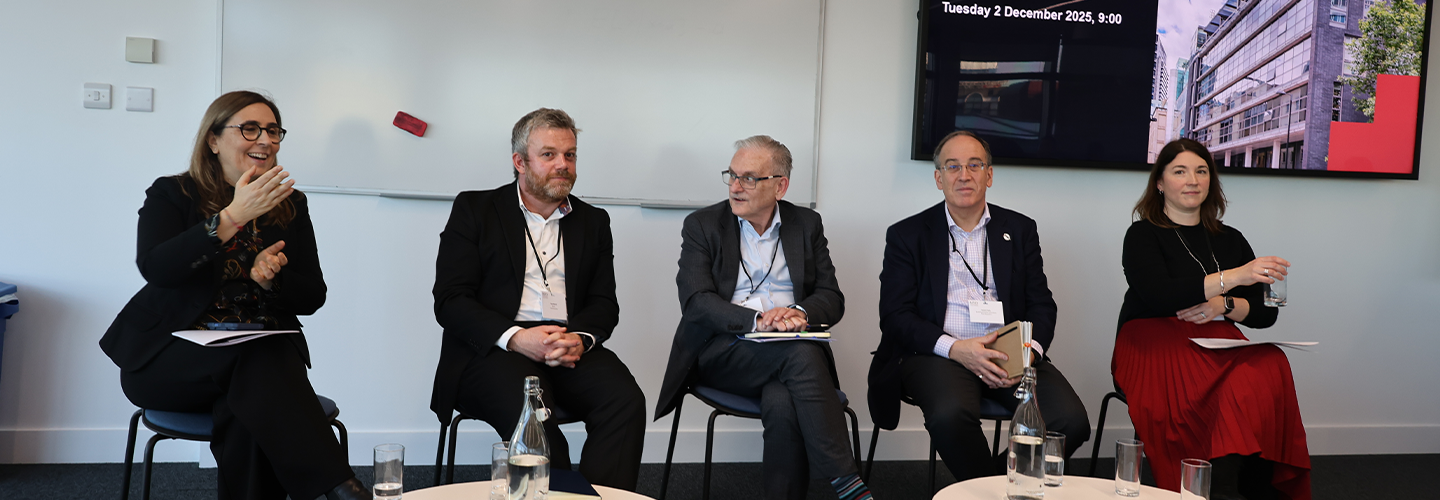
After a panel discussion featuring the sector’s leaders and Ms Wallis, chaired by Professor Casu, the workshop heard about a range of recent or ongoing research around financial mutuals. Topics included competition and risk segmentation, the effects of bank diversification on local firms’ growth, and banking development and the impact of natural disasters.
Andrew Gall, Head of Savings and Economics at the BSA, commented: “It was inspiring to hear the results of research into mutual and cooperative banks, which showed their positive impact in communities around the world. We also got a preview of forthcoming research on building societies, funded by grants to mark the 250th anniversary of the sector, which demonstrates how the sector remains relevant today. This research will help to inform the growth of the sector, alongside the work of the regulators announced today.”
Bayes PhD student Frank Chong presented a chapter from his thesis which concluded that tightened sector regulation in Canada following the 2008 Global Financial Crisis may have led to higher renumeration for mutuals’ executives.
Featured Bayes Experts
-
 Professor of Banking and Finance & Director of Centre for Banking Research
 -

-