Actuarial Science MSc programme reaches for the stars in anniversary event
Bayes is marking the 40th anniversary of its ground-breaking MSc in Actuarial Science programme. Alumni, students and academics gathered for a stroll through the actuarial landscape last week.
Halley’s Comet, ‘well oiled’ insurance brokers, agreeable Victorian dining clubs and the Second World War made surprise appearances during Bayes Business School’s recent celebration of actuarial science.
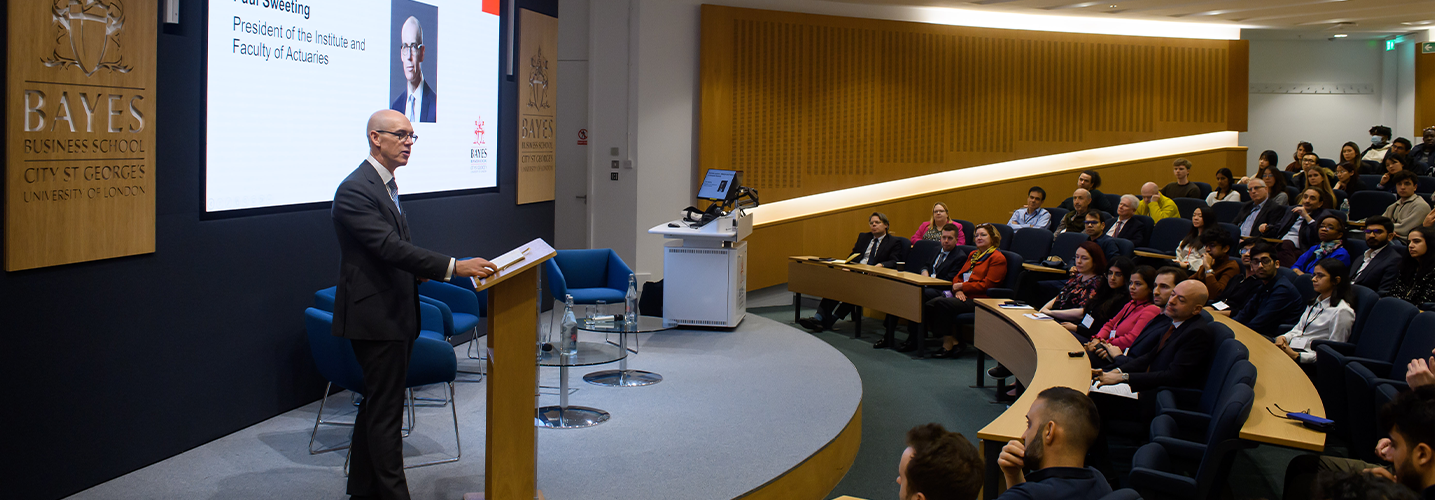
All featured in a presentation by Paul Sweeting, President of the Institute and Faculty of Actuaries (IFoA), that helped mark the 40th anniversary of the business school’s MSc in Actuarial Science. Paul, a Bayes alumnus, took a “ramble through the actuarial landscape” – charting the profession’s history before providing reassurance around its future, even in the age of artificial intelligence (AI).
Setting out the historical and economic backstory that explains the enduring importance of both the UK and the IFoA in global insurance and actuarial science, he took the long view.
Generals in ancient Rome, he noted, kept the troops onside with the promise of pensions. Workers in less dangerous jobs started to benefit from occupational pensions from the 12th Century. However, Paul explained, analysis and pricing of the risks and uncertainties in such guarantees, only emerged half a millennium later. As the turbulent 17th Century drew to an end, Sir Edmund Halley, created the actuarial profession – in-between discovering the comet named for him and being the Astronomer Royal.
It's written in the stars
Paul explained: “Halley is often regarded as the father of the actuaries, even though we didn’t have even the term actuary in those days. But if you look at his life story, constructing life tables was almost a footnote to what he did. He dropped out of university to go and map star charts in the southern hemisphere. Even though it was just almost an afterthought for him, it was really the first true actuarial analysis, which gave us those life tables that gave us an ability to price insurance products like annuities.”
Others refined his innovation so the price of an annuity could be turned into a regular premium – leading, in 1762, to the formation of the Equitable Life insurance company.
“You could tell that what they were doing was a good idea, because other insurance companies did one of two things. They copied Equitable Life, or they went bust. It showed that actuarial techniques were the way forward and during the first half of the 19th century there were a growing number of actuaries.”
These actuaries did what any educated, intelligent group of Victorians did and formed first the Actuaries Club, which is now a dining club, and, in 1848, the Institute of Actuaries, followed eight years later by the Faculty of Actuaries. For many decades they were the only such organisations in the world – which is why half of the IFoA’s merged 34,000 members live outside the UK.
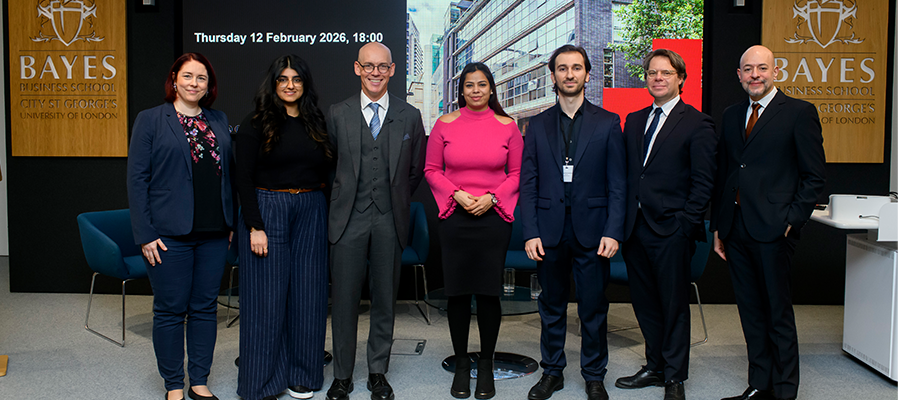
Above: (l-r) Hana Drake, Simran Dewani, Paul Sweeting, Meghna Sharma , Andreas Chatzineofytou, Professor Andre Spicer, Professor Ioannis Kyriakou
Other highlights of the three centuries between Halley developing his life tables and the 1985 launch of the Bayes MSc programme include British actuaries scheming to protect the capital from German flying bombs during the Second World War. Their calculations and predictions on where the bombs would fall enabled the British to mislead the Germans on the optimal fuel supply for such weapons.
In a bitter irony, they failed to predict that a flying bomb would destroy Staple Inn Hall, the historic IFoA HQ from where they did the calculations.
“Fortunately, all the stained glass had been moved to coal mines in south Wales and the hall was rebuilt – including with timbers gifted by actuarial associations around the world.”
He explored how regulatory changes, working practices and technology changed the profession through the 20th Century and on to today – highlighting the profession’s landgrab in the late 1960s and early 1970s.
“Actuaries were in senior positions in insurance companies and they started looking over the fence at the non-life part of the business – thinking we can probably do a better job at pricing this stuff than the guys who are currently doing it up. They started applying actuarial techniques to pricing non-life risks, general insurance risks, and found they're pretty good at it. And they also moved to the Lloyd's of London market to show that these techniques could be even more useful than an ability to drink an awful lot of beer at lunchtime, which is what brokers in that market tended to do at the time.”
Working with - rather than fearing - AI
That regular extension of the actuary’s potential remit encouraging words for those concerned about the implications of AI on the profession.
“I’m sure that when pocket calculators first came along, people thought, you know, we’re not going to need as many actuaries now, because you don’t need too many people to slide rules and square paper. When the first computers and spreadsheets came along, I wondered what all the actuaries were going to do. Yet the number of actuaries continues to grow. Like all new technology, AI is going to give us a wider range of tools that actuaries can use to solve problems – and to look at a broader range of potential scenarios.”
Bayes Executive Dean Professor Andre Spicer said the School was proud that the MSc Actuarial Science programme remained market-leading 40 years after its ground-breaking launch.
The programme, he added, has maintained its strong links with the companies alumni go on to work in.
“The 1980s was the decade when specialist master’s programmes were expanding and international students started becoming central to business school’s business models. We’ve seen major milestones as the programme has evolved – most notably with the pioneering integration of actuarial science with business analytics in 2020. We’ve also have been recognised as a Center of Actuarial Excellence by the Society of Actuaries and we partner with several academic institutions and regulatory authorities abroad.”
Professor Ioannis Kyriakou, Director of the Actuarial MSc Programme Cluster, said he felt privileged to be involved with the programmes.
“I am in my ninth year of service, and I feel honoured to be celebrating with you this 40th anniversary. We’re celebrating a proud legacy but also looking forward two, three, even four decades.”
Featured Bayes Experts
-

-
 Associate Professor of Insurance and Head of Faculty of Actuarial Science & Insurance


