
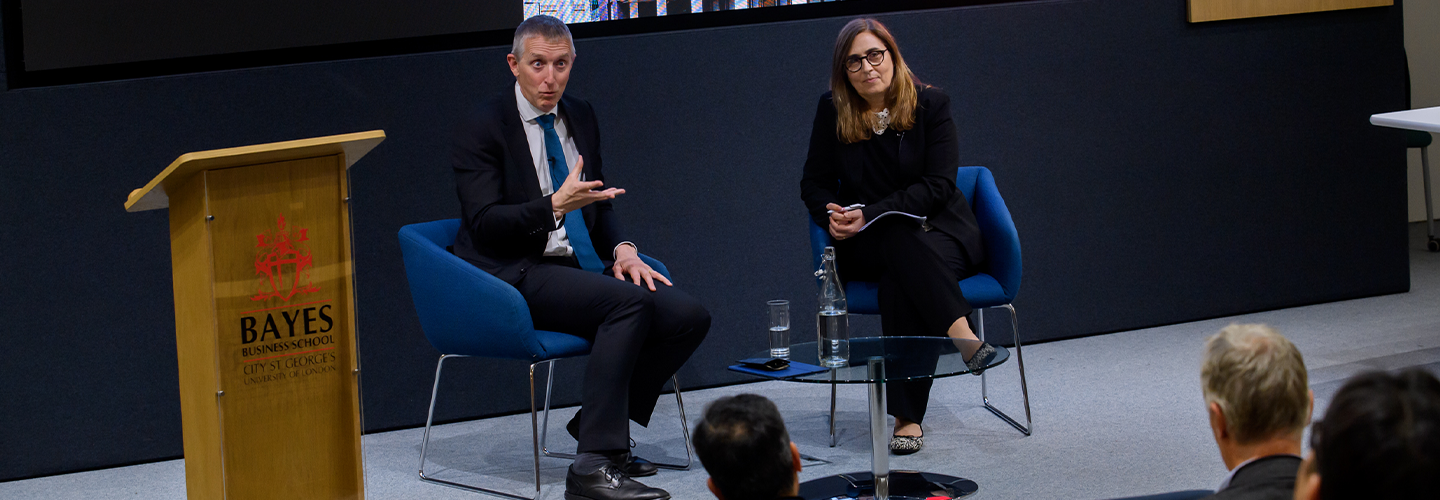
Bank of England boss explores banking supervision in lecture
Sam Woods, Deputy Governor for Prudential Regulation at the Bank of England, pictured above with Bayes Deputy Dean Professor Barbara Casu, explored the uniquely "peculiar" role of the banking supervisor in the 2026 Henry Thornton Lecture.
Banking supervision may evolve into a “profession” akin to medicine and the law, Sam Woods, CEO of the Prudential Regulation Authority suggested at Bayes Business School last night.
Delivering the annual Henry Thornton Lecture, which is organised by Bayes’ Centre for Banking Research, Mr Woods emphasised the level of expertise and range of skills needed to be a banking supervisor; which are rather more than those found in other government ‘inspectors’.
“It is necessary, but not sufficient, to be technically proficient at navigating various arcane topics of financial regulation like capital, liquidity and group consolidation. Supervisors also require a deep and holistic understanding of financial institutions, the risks that affect them and the psychology of organisations and individuals. To deliver on their mandates, supervisors need to be able to develop and maintain these skills, supported by a wider system which recognises the value of independent, expert, supervisors.
“But despite these demanding requirements, the qualifications and mindset to perform this role well have been quite loosely defined. Over time, I therefore wonder whether banking supervision may benefit from being viewed more formally as a 'profession' – akin to other such roles like doctors and lawyers.”
As technology advances, he suggested, supervisors are likely to devote more of their effort to risk identification, analysis, supervisory engagement and learning. Activities that can be standardised or automated through advances in data, analytics and technology will conversely consume less of their attention.
“This might in time mean a more senior and more specialised workforce,” Mr Woods said.
The Henry Thornton Lecture was inaugurated in 1979 to recognise the work of the 19th Century economist and banker who is renowned for several insights into the British monetary system during the Napoleonic era.
In his welcome speech , Professor Andre Spicer, the School's Executive Dean, noted that Mr Woods has been at the heart of the state's response to crises such as the 2008-09 Global Financial Crisis and the financial impact of the covid-19 pandemic.
Mr Woods took the audience of City workers, academics, Bayes alumni and students through a short history of banking supervision in the UK and U.S. as a way of highlighting the evolving role of bank supervisors – and just how different their role is to those of other public servants such as food safety inspectors and police officers.
Celebrating the peculiar
Returning to his theme around the near-unique role of banking supervisors, Mr Woods said the breadth of their role and the strength of their powers reflects the unique nature of banking and its peculiar ability to devastate whole economies.
“This (supervision, rather than inspection) is a relatively interventionist activity compared to the monitoring functions of many regulators, and one which is rather unusual in a capitalist economy.
“Research suggests that the average net present value cost of a financial crisis, even if well managed, is around 43 per cent of GDP. I wouldn’t quite put it this way, but there is a view that the motivation for bank regulation is that the state has effectively licensed money (and by extension, credit) creation to private actors who earn a return for performing this task; so it is natural for the state to wish to monitor, and be seen to monitor, those actors’ administration of such important public infrastructure.”

