
Arturo Rodriguez Fernandez
Nationality: Spanish
MSc course: Business Analytics
Graduation year: 2023
Taking the fast-track to an international career
“I studied engineering in Spain, but I realised I didn’t want to become an engineer. Instead, I knew I wanted to study Business Analytics.”
Arturo Rodriguez Fernandez is talking about his decision to relocate from Spain to London for the MSc Business Analytics.
“I knew it was a good option for me, because I was already comfortable with the technical side from my undergraduate degree – I love coding and data analytics. But I wanted that business perspective too. When I looked at other business schools, the approach was more academic and less practical. Bayes was different in that their approach to business is more hands on, getting students out there into industry to visit different companies and talking to people.”
“I come from a small city, so I wanted to leave and see other places. I thought London was the perfect place, because it is relatively close to my country, but at the same time, could give me a global perspective of the world and of business. I looked at different business schools in other countries, but London seemed like the best fit for all my requirements.”
The MSc Business Analytics is designed for people looking to understand how real-life business solutions are powered by analytics from a variety of sectors. Students develop a comprehensive set of contemporary skills essential to becoming a successful business analyst. They learn specialist and technical skills in data science and analytics, along with developing the soft skills that are crucial for influencing people and leading organisations. No previous experience of analytics skills is required, or knowledge of the technology needed to deploy them. Instead, students can join pre-courses which equip them with the minimum knowledge needed in technology such as Python and R Programming, before they start the 12-month programme.
Translating data into decisions
Arturo was attracted by Bayes’ practical approach to Business Analytics and found that to be the reality.
“When we had to apply what we were learning in class, we were doing so with real case studies, not mock-ups. Sometimes we’d even get to speak to the company involved. When you see how data analysis is translated into an actual decision, that’s when the learning makes sense. We also had the opportunity to select a business and do a case study with them – it was great to have this freedom to go out and find a company that was doing something unique or that could help our project.”
For Arturo, one particular highlight was the hands-on international elective he took in Portugal.
“I was working in Lisbon for a company that was then based in the UK. It was a consulting exercise, where we acted as consultants to an SME trying to solve a specific business problem. We spent a month working with them – the first week on site, and then three weeks online. I was working in a group with people from other master’s courses, which brings together a really diverse group of people. Being able to mix my skillset with students from other master’s, highlighted my strengths, but also what I need to do to collaborate with people from different backgrounds and how to look for synergies. It was like a snapshot of the working world.”
“It was a great experience, and valuable networking - I actually got a job offer from the company, so the experience really paid off. I didn’t take that job, but I have kept the relationship alive – I even attended their last Christmas dinner because I’ve still got a good relationship with the people there. “
A career that is going places
After graduating, Arturo secured a role with Alstom – a railway company which manufactures trains and carries out train maintenance. They are the largest train manufacturer in the world, and in the UK around 75% of the trains are either built or maintained by Alstom.
“I’m on the graduate procurement programme, doing different roles in procurement. That has included bids and tenders, and procurement analysis – which is exactly what I was doing at Bayes. We did a lot of coding, using Python, but at Alstom, it’s old-school Excel spreadsheets. It’s been great to apply a more advanced and technical approach to this work. I have also been doing a procurement analyst rotation for different departments – the procurement directors saw that I could find the root of some of their problems by doing data analysis, and they didn’t have anyone like that in the whole of the procurement team in the UK.”
“I’ve just started a new role as a Senior Commodity Buyer for all of Alstom’s IT. I’m in charge of buying the IT that goes on the trains for the UK and Ireland - the passenger information systems, driver operation, the CCTV etc.”
“I hadn’t originally planned to work in procurement but when I started to learn about it, it felt right. It’s great, because it’s the business side of the industry – you go to see the suppliers and negotiate with them. But at the same time, you need a lot of technical analysis and the pre-work that goes into procurement. So, it’s the best of both worlds and it’s been great. Because I am buying all of the IT, I get the underlying knowledge on the different parts of the business.”
“Having the engineering background from my undergraduate degree, and the coding experience from Bayes is a great advantage – I can discuss things with suppliers that people from a purely business background might not be able to. I’m actively involved in the business - I didn’t want to just spend 8 hours in front of Excel spreadsheets each day. I’m now travelling two or three days a week across the UK and Ireland, sometimes Europe, meeting suppliers. It’s a really dynamic role. It’s a bit crazy, but I love it!”
Developing skills to deploy in the workplace
“Although I was comfortable with maths and data analysis from my engineering background, Bayes really gave me the data mindset. We did so many data exercises and analysis, in so many different ways – from pure software coding to network analysis and machine learning. The way I understand data now is much different from before. I expected that from my master’s, but it was much more intense. Now I can approach a data set and know where to look to find a solution to the problem I’m facing. That’s given me a lot of confidence when I go and speak to management, because I know the data analysis is strong. My interpersonal skills have improved because my background is strong enough to support what I am saying. It makes it easier to go and discuss problems.”
“Another highlight of the year was networking. I was Vice-President of the Business Analytics Society, and we did several events with different companies – some for networking opportunities and some for careers awareness and seeing what opportunities are out there. I remember one where we invited experts to come and talk about Generative AI and how the underlying model worked, which was a great insight into something which is rapidly changing how business operates.”
“I attended all the events I could – at least one or two a week. If a society was doing something, I would attend, just to learn more about business in the UK.”
Support from the Careers Service
“The job market in Spain is so different from here in the UK. But by speaking to people from the School and different companies, I could learn how to apply for jobs, how to approach interviews and do assessment centres.”
“I tried to use the Careers Service as much as I could because at the beginning, I felt a bit lost on how to navigate myself through the job market. As soon as I started to engage with them, everything seemed much easier. I went to one of the Bayes alumni events recently and was speaking to some of the people from the Careers Service. They still remember me, because I did quite a lot of one-to-one sessions and mock interviews. I also did events to help me understand the job market, define a strategy for applications, and prepare for assessment days.
“Now I try to help them where I can – if they ask me to be a part of a careers panel, I’ll try to contribute because they were so helpful to me.”
Making London home
“I came to London with my girlfriend as we both wanted to do a master’s degree in the UK. The idea had been to return to Spain immediately afterwards, but after a few weeks in London, I realised that I love the city. I come from a small city in Spain, so everything here was intense – so many people, so many buildings to see, places to go. I really wanted to experience that for my career, as I am also looking for a global perspective into business, because I don’t know what I am going to do in the long term. London seems like the perfect place to get that wider perspective, because to me it is the capital of Europe – everyone is here, and you have access to everything.”
“From my time at Bayes, I realised that I am able to engage with people from so many different countries and backgrounds. I was worried my English language skills would make it hard to build strong relationships, but I quickly made friends, and language wasn’t the barrier I thought it would be. I actually ended up becoming the student representative for the course, so I engaged with the School committees and senior staff. I was able to build really positive relationships.”
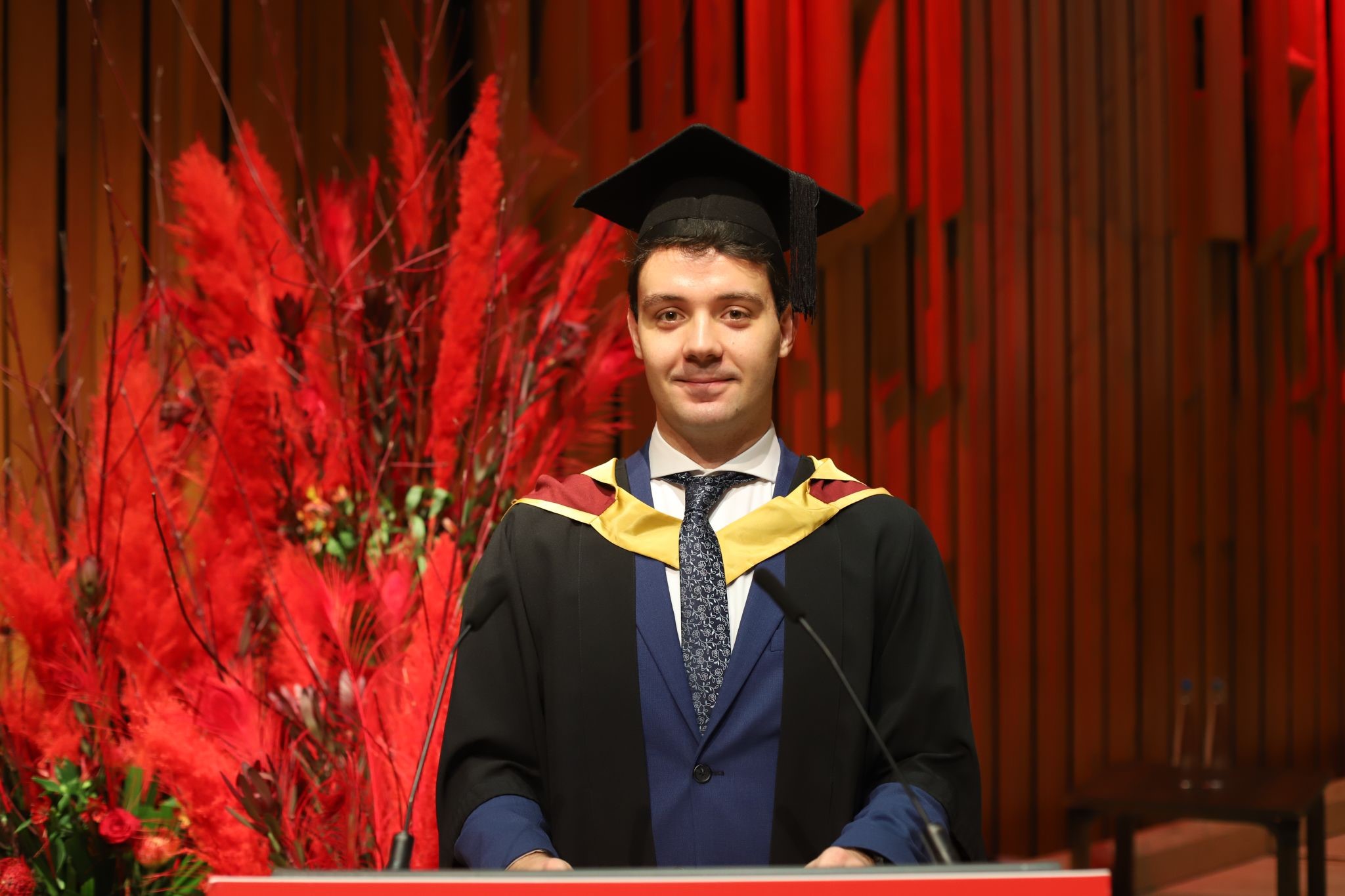
“My active role in the School led to me being asked to do the speech at the graduation ceremony. It was one of the proudest days of my life, because I had my family there. It was a great achievement for me to speak to my fellow students and people from the University. Even before graduation, I considered my time at Bayes to be perfect, because I enjoyed myself a lot. I got involved in every aspect of School life, got good grades and had several job offers. I was very happy, but graduation was the ‘cherry on the cake’ as you say. It was a perfect way to finish my master’s. I was very happy and proud that I could do that.”
Looking to the future
Arturo is optimistic about the future and the career track he is on.
“Things are going really well, and I’ve had positive feedback on all my graduate placements so far. I think the skill set that I’ve acquired during my year is exactly what I needed. The future looks good – there are plenty of opportunities, and plenty of challenges. Not only here in London but having a role with global opportunities seems feasible for the mid-term future. That excites me a lot and it seems like I can do some great things.”
For anyone thinking of following in his footsteps, Arturo has some advice.
“Do your research and be absolutely sure what you want to do. Because if you don’t have the motivation, it is hard to maintain the level that Bayes requires throughout the year.”
“Bayes offers so many opportunities and the highlight of my time was being as involved in School life as I was. I think I maximised my time at Bayes – I seized every opportunity and did as much as I could. I still have a very good relationship with people from my cohort, as well as students from other years, professors and people from across the School. I built a great network just because I was very involved in School life, and that will be helpful for the future.”
“If I were able to repeat my time at Bayes and do the master’s again, I would do it exactly the same way.”