
Marking 20 years of Quantitative Finance at Bayes
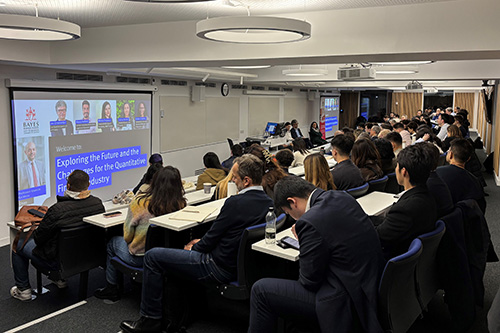
2025 is the 20th anniversary since the graduation of the first cohort of students from the MSc Quantitative Finance at Bayes Business School (then Cass). In that time, more than 1000 students have graduated from the course, from all over the world. To mark the anniversary, we asked staff and alumni for their reflections of the course, and how it has shaped the industry and those who work in it.
“A response to the Barings Bank scandal”
Professor Laura Ballotta is the current course director for the MSc Quantitative Finance and has been at the business school for more than two decades. She recalls the background to the course’s development:
“In the late 1990s and early 2000s we established several master’s programmes relating to financial mathematics and markets. The first to be designed was the course in Mathematical Trading and Finance. The emphasis here was more on the derivative market and teaching how to use derivative securities in a responsible manner, whether for investing or for hedging. It was partly a response to the Nick Leeson – Barings Bank scandal in the 1990s.”
“After that came the MSc in Financial Mathematics with more emphasis on the stochastic modelling and computational side of mathematical finance. This involved more on the analysis of market data and how to capture signals that can help in building a portfolio, and in asset management.”
“Following this, we thought there was a need for master’s with an emphasis on the econometric techniques that are used in the financial industry, and so the MSc Quantitative Finance was developed.”
“The three programmes together were covering more or less everything that the quant industry is about – combining mathematics, statistics and finance in a productive and efficient manner.”
At the time, we were at the leading edge - there were only a handful of other universities teaching Quantitative Finance.
Evolving with technology
Laura explains how the course has kept pace with rapid technological change since its first inception in 2004:
“The theories we teach are the staples, they haven’t drastically evolved – although the applications definitely have.”
“The biggest change is really in the technology – back in the early days we were programming in C++, and it was quite uncommon, so we had to teach everything from scratch. Nowadays, students are already literate in computer programming - they have familiarity with programmes likes Python and MATLAB. They want to learn how to use these to do things like scenario analysis and stress testing. And we’re starting to use generative AI with ChatGPT, which makes life much easier and faster.”
Our goal is to make sure that students have the necessary tools to keep up with the latest technological updates.
“The course today is analytical with an emphasis on quantitative skills, but it's not just theory, it's very much hands-on,” Laura says. She continues: “We try to combine the theory with the practice. Whenever I teach a theorem and show the proof, the second step is always, ‘why is it relevant? Where do you use it in the financial industry to solve which problem?’ This is the philosophy that we are promoting within the degree. We want to give students the skills that can help them enter the real world and do their job properly.”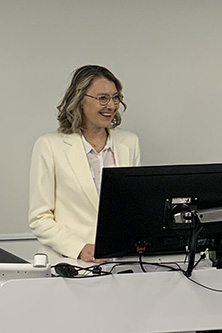
“My master’s helped me get my job”
One of the many graduates from the programme over the last 20 years is Suko Ndlovu, who graduated in 2021. Today Suko works as a data analyst for Mosaic Smart Data, which transforms transaction data into insights to drive revenue for Fixed Income, Currencies, and Commodities (FICC) markets.
“My master’s definitely helped get the job I have now. During the interview process one of the test exercises was based on financial engineering. The questions were very technical, but they were on subjects we had covered in the course.”
Suko continues: “I have been able to apply a lot of what I was taught on derivatives, financial mathematics and numerical analysis. The programme gave me an understanding of how the ‘front office’ views and uses the trade data. I wanted the course to give me a more rounded view and an understanding of how to support the function I was in - I wanted to understand where risk values come from, how they are generated and why they are important.”
Alongside learning about theories and applications, Suko recalls how her lecturers inspired her:
“The Bayes’ academics are passionate about what they do, and their passion overflowed into me. I'm very grateful for that because I'm at a place where now I can use that passion and knowledge in my job.”
“The class sizes on the MSc are small, so it’s very easy to have a lot of contact with your lecturer or tutor, and that’s something you don’t usually have in bigger universities. You can easily ask questions, and they are keen to impart their knowledge and share their passion.”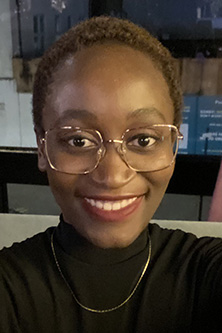
“There’s no better location than London”
Di Ai graduated in 2015, and has gone on to co-found an investment company, which focuses on advanced manufacturing companies in China. She credits the MSc Quantitative Finance for giving her a platform to build a successful career.
“The course laid the foundation for me to get into the market. As well as giving me the theoretical knowledge, Bayes offered lots of networking opportunities. I secured my first internship through a networking event, and that led to my first job in London working with a major venture capital firm. From there I moved into consulting for tech start-ups and then to co-found my own investment company.”
“There are great business schools all over the world, but if you are thinking about transitioning into a finance-based career very quickly, there’s no better location than London. Bayes really helped me to land smoothly at the start of my career.”
Looking to the future
Just as the course has evolved to fit the with times and the technologies then available, Laura says it will continue to develop:
“New markets have come in, like cryptocurrencies, and we have evolved with that. Also, there are new challenges to address. If we think about climate risk and what the quantitative industry can do to help to support the change that is needed to tackle this type of risk. It is evolving at a very fast pace – we wouldn't have we talked about climate 10 years ago the way we talk about it now. We have to reflect the world we are living in.”
The impact of AI
Part of that reality is the increasing role of Artificial Intelligence in student learning and the wider quants industry. Laura explains:
“The students are much more up to speed with AI technology because this is the environment they have grown up in. For us, we have to adapt and little by little, we are incorporating AI. Students already have a module on Machine Learning, which is now going to include AI. If used well, it can be an incredible educational tool. I know students that feed their lectures notes into AI to get additional practice tests and to generate multiple choice questions. It can be a very powerful instrument. The point is to understand where that stops and human intelligence, or ‘HI’, comes in. You have to know when AI is ‘hallucinating’ and producing false or inaccurate results.”
The potential application of AI is an area which excites Suko:
“We are using AI and Machine Learning but at a very small scale and I think there are more opportunities. There is so much data when it comes to finance, and we’re just capturing a small part of that. It’s going to be very interesting to see how that evolves and how we can apply the knowledge that we have to that space.”
“The Quant Finance industry evolves at a very fast pace, and we need to keep up,” Laura says.
“There is much more integration in the industry compared to when we first started 20 years ago. The goal of everyone involved with the course is to future-proof it for the next 20 years.”