One free MBA elective every year, for life
How Bayes MBA alumni continue learning long after graduation
When Mike Brotherston sat back down in a Bayes classroom earlier this year, nearly two decades had passed since he first studied M&A as a Full-time MBA student. In the intervening years, he'd bought a business, run it, and sold it. He knew what a deal felt like from the inside.
"After nearly 20 years, it felt like the right moment to refresh my knowledge and sense-check it against what I'd learned through experience," says Mike, now Managing Director of Emroso Ltd and working in consulting.
"I chose the M&A module having recently sold my business and moved into consulting. Buying and selling a business is complex, and I wanted to make sure I was sharp and credible when advising clients."
Mike's story is striking, but it's not unusual at Bayes. Every year, alumni return to campus, not just out of nostalgia, but because the working world keeps moving, and they intend to move with it.
An MBA is a starting point, not a finish line
The half-life of professional knowledge is shortening. Skills and frameworks that were cutting-edge five years ago may already be obsolete. Entire fields — AI strategy, ESG, digital transformation, private equity in SMEs — have shifted dramatically or barely existed when some alumni were students.
That's why Bayes MBA alumni receive one free elective module per year, for life, alongside continued access to Careers and Professional Development support. It's a recognition that the value of a business education shouldn't peak on graduation day.
Jose Puyana, who graduated from the Global MBA (Online) in 2023 and now works as a Principal Consultant at Transform, says the offer was a genuine differentiator when he was choosing between schools.
"Bayes offers MBA alumni access to one free elective each year, a unique benefit that truly stood out, as no other school I considered offered anything similar. As someone who genuinely enjoys learning, this perk was particularly appealing to me."
Coming back with real experience changes everything
For Mike, returning to the M&A module wasn't about filling gaps in his knowledge. It was about reframing what he already knew.
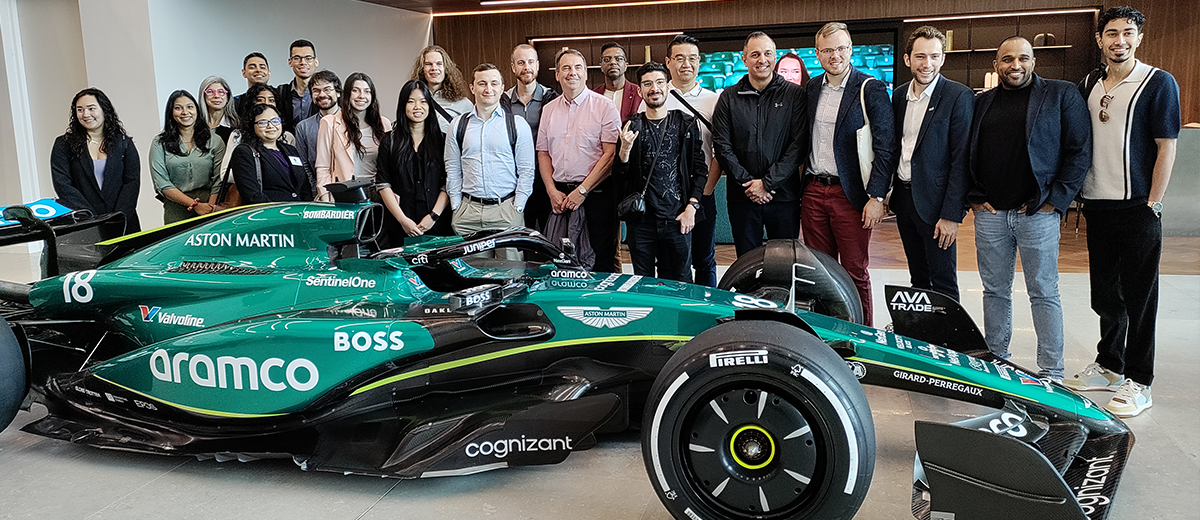
"The EMBA cohort I was with (pictured below) brought a wide range of senior, real-world experience, which made debates fantastic," he recalls. The classroom had changed too — a new building on Finsbury Square, a more diverse mix of backgrounds and perspectives, and a curriculum that had evolved with the times.
The fundamentals of M&A, Mike notes, remain largely unchanged. What has shifted is how they're applied. "The course now includes more SME-focused examples alongside large corporate deals, which is important as many MBA graduates will ultimately work with, invest in, or run smaller businesses where the dynamics are quite different."
There was also a clear thread running through the module on the use of AI to accelerate analysis but always with the expectation that students could explain their reasoning, not just their outputs.
The practical impact has been immediate. "Having bought, run and sold a business, the module helped me reframe those decisions through a different lens. Combined with the broader M&A frameworks, that's been valuable in client conversations, especially when helping business owners think through growth, exits or strategic change."

Learning shaped around where you're going, not where you've been
The elective offer is genuinely flexible. Alumni choose modules based on where their careers have taken them or where they want to go next. The curriculum spans sustainability, behavioural finance, digital strategy, new venture creation, private equity, and much more. As new topics emerge, new electives follow.
Not every elective is about technical upskilling. For Kai Li Loh, Full-time MBA (2022) and now a Senior Consultant at Lumanity, the annual offer is reason enough to choose Bayes in the first place.
"If future students need a reason to choose Bayes, it would be the one free elective each year. It really emphasises the value of 'always learning'," she says. Shortly after graduation she returned for the London Symposium: four days of world-class speakers, and a chance to reconnect with the Bayes community. "It's a refreshing pace, and a great way to reconnect with who I was as a student."
Sabina Jasinska, who graduated in 2016 and now works at Chief Marketing Officer at Hansen Technologies, has been returning ever since, and she notices how the School moves with the times. "The addition of new electives, subjects such as sustainability or AI, the new businesses invited to events like the London Symposium — you see that evolution year after year," she says. "I feel really proud that I graduated from Bayes and that I'm still here, taking advantage of the immense network the School provided."
Tatiana Ryabinina completed the Modular Executive MBA in 2020, then launched her own management consultancy before moving into her current role as Localization Manager at PandaDoc. Across that career evolution, the elective offer gave her something genuinely useful at the moment she needed it.
"I decided to take advantage of the free alumni electives. I chose to do New Venture Creation and Managing Strategic Change as these electives aligned with my business goals of growing the international client base and implementing strategic and organisational change."
Her experience illustrates something important: the value of the offer isn't fixed at the point of graduation. It bends to fit wherever your career takes you — whether that's launching something new, scaling it, or moving into a different role entirely.
The compounding value of staying connected
Luca Poggiaroni, an Italian entrepreneur who studied the Bayes Evening Executive MBA, used his alumni electives to pivot into a new chapter entirely. After completing the MBA, he joined Arc Consulting and later took on a senior role at Azimut Direct, a fintech investment company.
To build the knowledge he needed, he returned to campus for both the Private Equity and M&A electives. Each center on teaching core skills in strategy and finance, as well as technical knowledge regarding venture and buyout returns and Private Equity funding.
"I took those electives because of my new career at the time. I had to learn about it," he says. Beyond the curriculum itself, the electives also reconnected him with the Bayes community. "It's an opportunity to come back to London to catch up with some friends. So I will choose to do another elective."
This is the compounding logic of lifelong learning: every return builds on the last. The network deepens. The knowledge stays current. The credential keeps earning its worth.
What this means for candidates shortlisting now
If you're weighing up business schools, the question isn't just what will I learn during the programme? It's what will this degree be worth in ten, fifteen, twenty years?
At Bayes, the answer is built into the offer. One free elective per year, for life. Continued access to careers support. A curriculum that adds new electives as the world changes so you can come back for topics that didn't even exist when you graduated.
Staying sharp enough to navigate those questions, year after year and decade after decade, is exactly what Bayes is designed to help you do.