
Lauren Pilgreen

Programme: Modular Executive MBA (2024)
Nationality: American
Pre-MBA: Business Development Manager in a creative agency
Post-MBA: Head of Startup Innovation, Sustainable Ventures
Current Industry: Innovation and venture capital in climate technologies
“My MBA gave me all the tools I needed to pivot my career”
Lauren Pilgreen’s journey to her Modular Executive MBA at Bayes Business School, took in career stops all over the world, including Los Angeles and Shanghai. Finally landing in London, Lauren has spent the last decade slowly moving away from her fashion design background, and into her dream job working with sustainable start-ups.
“I’ve had what is called a ‘non-linear’ career. I originally came from the fashion industry and had a whole career in design and product development. But just before I joined the MBA, I was working as a business developer at a creative agency in London.
“I started specialising in design when I was very young, but I soon realised it wasn’t for me. And since then, I’ve been trying to change my career path, one step at a time, to work my way into what I knew in my heart was what I wanted to do – to help start-ups scale.
“The motivation behind the MBA was to make a serious move away from these small changes and really pivot my career.”
Choosing Bayes for her MBA
When researching where to take her MBA, Lauren sought advice from those who had already studied at Bayes.
“I had a small handful of friends who had either done the Evening Executive MBA, or the Full-time MBA. Everybody I spoke to absolutely loved their experience at Bayes – they told me it was a fantastic programme and the teaching is exemplary.
“I had my admissions interview with Dr Alessandro Giudici, the Course Director at the time, and he shared with me how creative, supportive and enthusiastic the cohort is – ‘it’s not a shark tank but a pod of dolphins’ was how he described it. It was exactly what I was looking for.
“Another thing that attracted me to Bayes, was the innovation mindset – and their appreciation of my past failures. In 2018 I started a social enterprise that connected a community of emerging artists with commercial opportunities, focusing on live pet portrait drawing at charity dog shows. It was a terrible idea for a business, but it was so much fun. I told Alessandro stories about disastrous pitch meetings, where it was abundantly clear I was failing, but the lessons were priceless. He loved those stories! It reassured me that Bayes was the right place for me, because failure is not seen as a weakness but a lesson for future success.”
Juggling work and study
Lauren found adjusting to the pace of the MBA was initially challenging.
“It was very difficult for the first few months, but I think once you start to get into a flow, it's easier. I was just starting a new job, so I was quite frazzled juggling everything. But the more time passed, the smarter I got about the way that I worked. In group projects I leaned on the team to work collaboratively, where we would play to each other's strengths rather than trying to do everything individually.”
Within three months of starting her MBA, Lauren secured a new role at Sustainable Ventures, which supports climate start-ups with investment, workspace and expert guidance.
“Being able to apply what I was learning on the programme directly to the start-ups I was supporting at work, was the best outcome. It meant the knowledge got solidified quickly, and I was able to see how it was helping others.
“The MBA really was the best tool I could have had for helping my career. Doing it part-time while working forced me to be more disciplined and meant that I could use the learnings immediately in the business and make a difference.”
A curriculum with impact
In the first year of the Modular Executive MBA programme, participants take core modules on topics such as Strategic Leadership, Financial Markets, Business Economics and New Venture Creation. In year two they choose from a wide range of elective modules which can be tailored to specific career goals.
“Of the core modules I took, I found that Corporate Strategy and Corporate Finance were very useful, because I had gaps in my knowledge. I work in and around finance dealing with things like equity, debt, and grants, and now I have a much better understanding of the mechanics at play.
“Of the electives, one module that I absolutely loved was the Tech for Social Good trip to Kenya. Sustainable Innovation is very much my area of business. I love meeting start-ups, and it was particularly interesting to see how they adapt to an environment where capital is hard to come by and technologies are not as mature – and where everything has a social impact because it’s all about improving quality of life. It was fascinating to see how those start-ups come together to get international investment, when government support isn’t available."
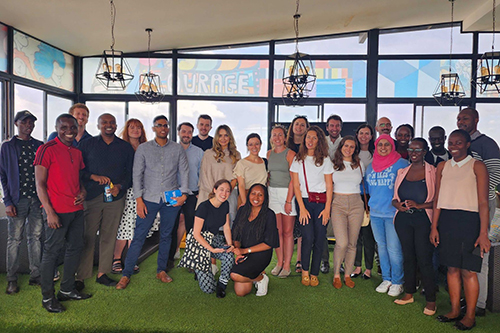
On the 'Tech for Social Good ' elective module in Kenya.
“One of the founders we met was Francis Nderitu, Founder and Managing Director of Keep IT Cool (KIC). His company provides sustainable refrigeration and smart distribution solutions for small farmers and fishers, and has just won an Earthshot prize. It was so inspiring to hear his story and about the growth of his team.”
Professional development support
From the beginning of the Modular Executive MBA, the Careers and Professional Development team are on hand to offer support. Through one-to-one coaching, career management workshops and the Achieving Your Potential weekend, they work with participants to test capabilities and bring career goals within reach.
“I love the Careers and Professional Development team. I went to them very early on because I was in ‘career pivot mode’. I had found a job opportunity with Sustainable Ventures and so I asked them for help to review my CV and work on my personal branding. They were both critical and helpful, and sure enough I got the job!
“All of the professional development activities on the MBA were useful in helping me understand my career trajectory. It really got me into self-reflection mode – asking questions like ‘what am I good at?’ and “where can I make an impact?’”
Using the Business Project in the workplace
Lauren undertook the second-year Business Project with her company Sustainable Ventures, looking at the future of climate tech investing.
“I researched the historical trends around what types of technologies were being funded, and where they are now. I interviewed multiple start-ups to see what they needed, identify the gaps and to consider the future of funding. It had a real focus on the practical – what things do start-ups need to do to get themselves off the ground and at what cost?
“Originally it was just me and the CEO working on it, but as we started to consider the issues, we pulled in different parts of the business to help, such as the investment team and the venture team. Everybody was interested in feeding in – it was a creative collaboration and a great opportunity to come together and strategise and see where you can improve different areas of the business. I think that was the real value of the Business Project.”
Engaging current MBA students
In her role as Head of Startup Innovation, Lauren is keen to strengthen her professional connection with Bayes.
“At Sustainable Ventures we have a portfolio of 50+ investments in the climate space. We have a whole suite of really exciting technologies, like 3D printed steel beams and metal-free and chip-less RFID tags. We’re looking at which companies would really benefit from some consulting support from the MBA students. The companies get some free consulting, and the students get the opportunity to do real-world projects and understand whether the start-up life is for them. It might also start a recruitment funnel of students being recruited into those companies as they grow.”
Advice to prospective students
Lauren is unequivocal when she talks about the impact of her time at Bayes:
“The MBA was 100% the best thing for me to do to get where I wanted to go. I needed to explore other avenues and be very critical about how I moved forward as a professional.
“To prospective students I’d say, ‘absolutely do it’, but I would challenge them to be really clear about what they want and why. If they go in with clear intentions, they will make the most of it.
“I would also advise them to stick with it because the first year is hard. You might feel out of your depth, or totally unequipped and like you aren’t good enough to be there. But there is a change that happens. For me it was shifting to the 80/20 rule and realising that I didn’t have to do everything 100% perfectly all the time. Recognising that I had to let go of this perfectionism – that was a total game changer.
“Once you realise that you are good enough, exponential growth follows.”