
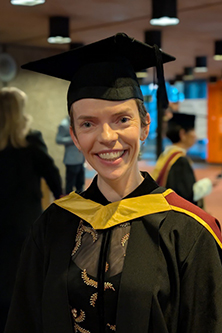
Stephanie Coughlin
Transition: Function
“Why did I do the MBA? To open doors and drive a change in my career”
“I believe a career is a lifelong journey which takes many paths. When I turned 40, I felt I had reached a crossroads in my career, and I was eager to explore what other avenues might be open to me.”
Stephanie Coughlin is reflecting on her motivation for taking an MBA at Bayes Business School.
“I was enjoying the work I was doing in the NHS looking at the commissioning of services and working as a GP. I felt it was making a difference to patients and improving services. But I started to look at gaps in my skills and knowledge and what might help me to progress my career in the NHS while still being a practicing GP.”
“As a doctor, you spend so many years studying medicine, but you don’t necessarily learn about business and working at scale. I had some gaps in areas such as finance, accounting and strategy, and I knew that I would need to fill these for the roles I was looking to do. I wanted something that could open doors to drive a change in my career.”
“One of the frustrations I had in my leadership career up to that point was that as a clinical leader you can get pigeonholed. It is accepted that you can design a pathway and a service based on patient needs, but people don’t talk to you about the budget because they assume you don’t know about these areas.”
“I remember spending several months working with a group of other clinicians to develop a new pathway. We had done a really good piece of work, but then the managers said, ‘we don’t have the money to implement it’. I remember thinking ‘why didn’t we have these conversations together at the start?’ The project was never going to be successful because all the different parts of the jigsaw weren’t linked together. It was a driver for me to really want to understand other business functions and be able to talk the language with confidence. I felt if I didn’t, things probably wouldn’t change. I was looking for a role where I would be empowered to look at both service design and budgets, and I felt the MBA would not only enhance my skills and capabilities but also how I was perceived. It is an internationally recognised qualification that spans different sectors.”
An MBA that fits around work and home-life
Stephanie chose Bayes’ Evening Executive MBA programme, which is delivered in person, two evenings a week. The evening format enables participants to balance their studies with their career and personal commitments.
“I have three children and a full-time job. I didn’t want to leave my job to study full-time and the weekend model wouldn’t have worked for my family. The Evening Executive MBA felt the most manageable given my other commitments, and Bayes has a great reputation. When I visited, I liked the feel of the place and the people I met. Plus, the location worked for me – I live in east London and work in Hackney. Another key deciding factor was that I was awarded a Women in Business Scholarship in support of my fees. I found out about that during the application process, and it made the MBA possible.”
Learning with impact
The Evening Executive MBA delivers advanced leadership skills, strategic thinking and a global perspective. It enables participants to navigate complex business challenges and drive impactful change, both within an organisation and the broader landscape.
It is ideally suited for executives with leadership or management experience, and attracts a diverse cohort of senior executives, leaders and entrepreneurs.
“I met such a range of people from a broad spectrum of sectors – such as property, law, tech, marketing, and construction. I wanted to open my eyes to other sectors and a more corporate environment. Although I didn’t want to leave the NHS, I wanted to understand what it is like to work in different sectors.”
The programme’s core compulsory modules cover areas such as strategy and finance, global economy and investments, operational excellence, sustainability and innovation. Elective modules allow for a deeper dive into core areas and the chance to explore specialisms such as data analytics, digital transformation and AI, Fintech, Private Equity and Mergers & Acquisitions.
Many of the modules had a profound impact on Stephanie.
“One that was quite unexpected was Corporate Finance. It was less about the number crunching, and more about how you perceive and understand how money flows through an organisation. It changed the way I think about finance and resource allocation. I hadn’t ever had the opportunity to think that way. We covered corporate finance and strategy and how you prepare for big organisational change. Those are things that I use now and can apply to any organisation.”
“Business Analytics was another module which made an impact. How do you think about and process data and what are the questions which you need to be asking? That’s incredibly relevant to the health sector because we are using data all the time.”
“Design Thinking was another which surprised me, in a good way. It looked at how you design a space and think about flow. That was more useful than I expected, because we look at new builds in health. When you design that space, have you built a prototype to consider the flow of people within that space and what it means for the patient? In the module, they made us mock up prototypes out of cardboard, and I’m there with Sellotape and scissors thinking ‘what am I doing?’. But having done it, I totally understand why.”
Gaining a global perspective with international electives
“Taking the international electives was the best decision I ever made.”
“In the first year I went to Nairobi to do a consultancy project with small and medium-sized companies. We worked with someone turning recycled plastics into building materials. It was a lot of work, but also a lot of fun.”
“When you are visiting these cities with Bayes, you have incredible access that you just wouldn’t get as a tourist. In Seoul, we got to understand so much more about the culture. We went to the embassy and to large conglomerate organisations and got an amazing insight into how they operate.”
“Having been on the trip to Seoul I was unsure about whether to do the San Francisco elective, but someone from my cohort who also had children encouraged me to join her. I thought with all the commitments I have in my work and family life, when am I ever going to get the opportunity to go away by myself again?”
“In San Francisco we got access to Berkley University, to start-ups and venture capitalists working in the Bay area and in Palo Alto. We also got to go to Google – these are things I’d never get the chance to ever do normally.”
“The great thing about Bayes is that as an alumnus you can come back and do a module per year, and I’m excited to do another module on strategy that my classmates praised so highly. I’d also like to do another international elective in the near future.”
Sector-leading careers and professional development
From the start of the MBA, the Careers Team are available to support students throughout their journey at Bayes. Through one-to-one coaching, professional development workshops, and the 'Achieving Your Potential' weekend, they help participants to explore and achieve their goals.
“We had some brilliant professional development workshops. One that comes to mind was media training, where we got to do mock radio and TV interviews. We also had one on presentation skills which completely changed my outlook and approach to presentations. It covered how to capture the audience and how to create the story to get your message across. We got ’20 top tips’ for presentation skills, which I still use today. Another great workshop looked at executive presence – no one teaches you that. It considered how to have executive presence while still being authentic to your true self.”
“I also worked with a career coach, which helped me prepare for a new role I’d secured while still completing my MBA. The coaching helped me to focus on what my first 100 days in the new role would look like.”
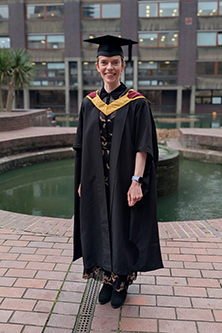
Applying MBA learning to benefit the NHS
During the second-year students complete the Business Integration Project, a major piece of self-managed work. It aims to develop skills in research and analysis, in a multi-disciplinary business environment.
“The Business Integration Project was a lot of work, but I took the attitude that you get out what you put in. I had a brilliant supervisor in Professor Amanda Goodall, who was amazing.”
“I wanted to use the project as something which could have an impact on my career, but that would also be useful to people working in a similar area. It was very much connected to my work, but around a topic I wouldn’t necessarily have the time or luxury to investigate. I did it on a policy shift within the NHS that was looking and how to move services from the hospital to the community. I considered it from the professionals’ perspective, and their perceptions of this shift. I did a national survey and conducted structured interview to get their opinions.”
“The outcome of the project is that I have something that is useful for people working in my sector. I’ll be able to take it to conferences and write guest blogs, and so it has a life beyond the MBA.”
Today, Stephanie is an Executive Director at Homerton Healthcare NHS Foundation Trust, which is an integrated community and acute trust in Hackney.
“My job title is Chief Partnership and Place Officer. The role is leading our strategic approach to community services and our work with local partners and providers. I'm still a GP, and I practice clinically for a small part of the week. Keeping some frontline experience is important because then I’m facing the same opportunities and challenges as other frontline practitioners and can apply that insight into the strategic work I am doing.”
“My MBA experience has given me confidence in my abilities to engage, ask questions, and understand the issues across a lot of different streams – whether that’s strategic, operational or financial. I still look back at my notes from certain modules for the frameworks and approaches we covered.”
“The professional development aspect of the MBA really helped too. From the career coaching to all the relevant workshops – they are all the building blocks which help you get a new role.”
Advice to prospective MBA candidates
“A career is a marathon and things aligned so that I could do the MBA when my children were a bit older and I wanted to do something different. It’s a huge commitment so have a really clear purpose about why you want to do the MBA and choose the time that is right for you. Whatever external commitments you have, there will be multiple logistics to juggle, so you have really got to want to do it.”
“I have so many highlights from my time at Bayes – the international electives and the Business Integration Project being just two. Best of all, I had an incredible cohort, and I learnt so much from them. You really go through a lot together, but I have made some friends for life. My MBA was an unforgettable experience which continues to shape my professional life and has forever changed me as a person.”