
Bayes lays out research’s role in addressing global challenges
Bayes academics publish the first in an ongoing series of white papers and thematic overviews to highlight partnership opportunities around research.
Bayes has published four overarching thematic reviews bringing together the school’s expertise in tackling the challenges facing governments, business and wider society.
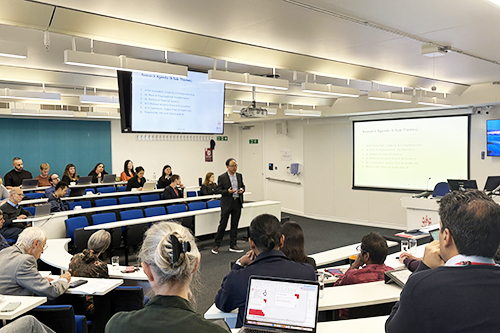
Speaking at the annual Bayes Business School Research Day, the School’s Dean, Professor Andre Spicer said the positioning papers provide a clear framework for current and potential external partners to explore possible partnerships with academics.
“At Bayes our world leading researchers are taking on some of the biggest challenges which business face today. These include how firms can harness the power of AI, how business can help tackle societal challenges like an aging society, how we lead through geopolitical turbulence, and what the future of banking and insurance look like.
“Our research can help businesses by offering independent, rigorous and practical insights with a long term view.”
“This white paper series is an invitation to engage with our work. In the coming years, we look forward to working with partners to apply high-quality research insight to the issues affecting their organisations, sectors and communities.”
The four overarching documents are each tied to one of the School’s cross-cutting research themes. These are:
- Alleviating societal challenges
- The future of finance and insurance
- Technologies and innovation, with a particular focus on AI
- Making sense of the transforming world.
Academics will produce white papers on sub-themes around issues such as central bank digital currencies. The agendas set out in the first four papers will continue to evolve as new issues emerge. On the AI theme, for example, Bayes academics are already exploring issues around agentic AI and embodied intelligence.
Professor Feng Li, the School’s Associate Dean for Research, said the white papers and thematic reviews will foster connections between academics and other stakeholders and potential partners.
“This will help bring people together and identify possible partnerships. Working together, we can tackle emerging issues around technology and what the future might look like for different industries. The positioning papers articulate our strengths as a school but also highlight some of the issues we can address.
“They don’t offer slogans, reassurance or fashionable language dressed up as insight. The series will bring serious research to bear on the practical and institutional questions now confronting business and society. This means looking beyond surface disruption to the deeper shifts underneath it, questioning inherited frameworks where necessary, and engaging with firms, policymakers and other partners who recognise that older approaches are losing their relevance.”
You can access the initial positioning papers and find further information about forthcoming white papers here.
White paper series No 1: AI and the Future of Business
Artificial Intelligence is becoming an operational necessity within organisations, to the point where they are no longer asking themselves if they should adopt it but rather how they can maximise its potential use.
For this to happen, managers must deploy AI responsibly and at scale to allow organisational and societal growth. The AI and the Future of Business positioning paper sets out how Bayes research will explore AI as a tool for organisational growth, creativity, financial and actuarial decision-making, and healthcare and operational systems management – as well as how to use it ethically and sustainably.
White paper series No 2: The future of finance and insurance
Finance and insurance are entering a period of accelerated transformation in which AI, digital platforms, climate risk, cyber risk and geopolitical uncertainty are reshaping how risk is assessed, priced, transferred and governed.
AI will not simply make finance and insurance faster or more efficient; its greatest value will come from helping professionals interpret complex data, improve decision-making and strengthen trust, while remaining subject to human judgement, ethical oversight and robust governance.
The future of finance will depend not only on technological adoption, but on whether financial institutions can remain resilient, trusted and socially useful in a world where uncertainty is more systemic, data-intensive and interconnected.
Insurance faces a growing protection gap as climate change, cyber threats, supply-chain disruption and emerging liabilities create risks that are increasingly interconnected, difficult to model and, in some cases, harder for private markets to insure alone.
White paper series No 3: Tackling Societal Challenges
Many of the pressures now confronting society do not sit outside business or government as background conditions. They run through the systems on which health, welfare, production and public legitimacy depend. Ageing populations are reshaping the fiscal and institutional foundations of pensions, care and healthcare. Health systems face rising demand, constrained resources and the persistent difficulty of shifting from treatment to prevention.
Decarbonisation reaches far beyond environmental policy into trade, infrastructure, supply chains and competitiveness. Responsible enterprise has become harder and more consequential as trust weakens and the limits of shareholder primacy become more visible.
These challenges are interconnected. This white paper examines the strategic and institutional choices that will shape how these pressures are managed in practice, and sets out an agenda for research and practical engagement. The question is not whether they
White paper series No 4: Adapting to a Transforming World
How can organisations and institutions adapt through global instability? Which experts can we trust? How can we bring together finance, technology, geopolitics and sustainability as part of a wider systemic interaction?
COVID, conflict and trade wars have served to heighten global tensions to the point where integrating risk analysis into financial and operational decision-making is not seen as mere prudence, but a vital activity of global businesses and policymakers.
This positioning paper details how these challenges are changing in detail, setting out how today’s leaders can ensure sustainable finance and ESG practices, cut through disinformation to earn trust, and navigate a shifting landscape to create a brighter future.