
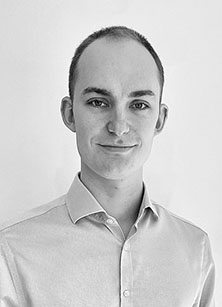
Tom Heywood
Transition: Function
“The key to a successful MBA? Build relationships with everyone you meet.”
“I thought an MBA would be the perfect opportunity to broaden my skill set and give me greater confidence in my leadership abilities.”
Tom Heywood is reflecting on his motivations for taking an Evening Executive MBA at Bayes Business School.
“I am an engineer by background, and after leaving university I joined an international company called Cundall, an engineering design consultancy specialising in the built environment space. Over the last eight years I’ve worked my way up the ranks, focusing on data centre design. We design and build some of the world’s largest and most innovative data centres, which is a booming industry.”
“I really enjoy what I do – the team are great and the work is interesting. Prior to the MBA, I was getting lots of technical experience in the role, but I didn’t really know how to set up and run a business, or how to interact on different levels in terms of finance or leadership. I thought the MBA would give me confidence in those conversations. I also wanted to become a better leader in my company, as I was on track for promotion to more senior roles.”
“Bayes was a good fit for me”
Bayes Evening Executive MBA gives executives the skills and knowledge needed to advance professionally, stay competitive, lead effectively and to navigate complex business environments. It is offered two evenings a week over two years, in a format that allows executives to balance careers, personal commitments and their studies.
“The format really appealed to me, because I wanted to fit my studies around work – I didn’t want to take a long period out of the workplace to do my MBA. I also wanted to be able to immediately apply what I was learning in lectures to my daily role at Cundall.”
“I looked at several London-based business schools – considering elements such as course structure, career development and price. The impression I got from the academics and admissions staff I spoke to, was that Bayes was a place where collaboration was important, with everyone working towards a common goal. Some other business schools felt a bit more cutthroat, where you are out for yourself to maximize your personal gain.”
“I also had personal recommendations from previous Bayes students, who had wholeheartedly recommended the school and the course.”
“As a prospective student, I sat in on a few lectures, and it felt very much like being in a company workshop or roundtable. People were throwing in ideas, some of them wild and outlandish, but contributions were welcomed and no one was getting shot down. It felt like a really good learning environment, and I enjoyed the approach.”
Learning with impact
“Given I already had a technical background, I found the modules looking at softer skills were really valuable. Particularly ones relating to leadership and HR. In an engineering consulting context, you don’t necessarily get taught how to lead people. You get promoted because you are good at what you do – that doesn’t automatically mean you are a good people manager or leader. The MBA gave me some grounding and context, with both academic research and situational learning. That was really helpful and has put me in good stead as I’ve been promoted twice in a relatively short space of time.”
“As I have progressed into more senior management roles at Cundall, it’s been helpful to have that skill set and broader business understanding as you are expected to know what’s going on. It has also made me more comfortable to question and probe, both within my company and in wider client teams.”
Developing well-rounded leaders
“The MBA has been really useful in how I lead my current team, and it’s made me a more well-rounded leader. I have always led with an empathetic approach, but the MBA highlighted a few of the pitfalls of that method. You can’t always be listening out for every voice – sometimes you have to drive the team towards a better result.”
“Because the MBA helped me understand what I want from my career, I can now help my team consider this too. I’ve started to encourage a regular process of people reflecting on their career aspirations and pushing conversations about professional development, so they can get the most out of it.”
“One of the biggest benefits of my time at Bayes is that I now have a better understanding of the wider business environment, not just my area of expertise. It has given me a different lens on business more broadly. I’m now also much happier and more confident about building my network – Bayes showed me how valuable and important that is, and it gives you so many opportunities to do it.”
Gaining diverse business perspectives
“The international electives were a real highlight of the MBA. I went to Nairobi, for the International Consultancy Week – that was full on but really good fun. We worked with a business called Drive Electric, who repurpose old electric vehicles. They wanted help and advice on strategy and finance.”
“I also went to Seoul, South Korea, for a technology and innovation tour, visiting different businesses and seeing how they operate. It was fascinating. I had never been to that part of the world before. From both trips, there is so much to learn from looking at how different business cultures operate. The international electives are also brilliant opportunities to get to know people from across the different MBA programmes. I’m keen to go on another international elective soon, and I have been discussing it with my cohort, who I still see regularly.”
Continuing Professional Development
“Another great thing about the course is the careers support and ongoing professional development. I got so much from the Achieving Your Potential residential weekend. It was a real deep dive into what you want out of life – exploring what motivates you, where your drive comes from. It was challenging at times, and prompted both tears and laughter in the room, but everyone came away from it having done a good deal of thinking about what they really wanted from their career.”
“Throughout my time at Bayes I had several meetings with Alexander Cross, (Head of Leadership & Career Development), about job roles, updating my CV, and thinking about different career options. It was really helpful to bounce ideas off the Careers Team and use their valuable experience.”
Juggling work, study and family life
Tom became a father while studying for his MBA, so juggling homelife, work and study became even more important.
“It was a challenge for sure, but I’m quite a logical and organised person by nature. I just needed to dial that up to the max to fit everything in. For me it was manageable. Some things did have to give – there would be the odd weekend I’d have to turn down social engagements, to get everything done. Communication was key to making it work – with my wife, with my project supervisor and with the department.”
Forecasting the future
During the second year of the MBA, students complete a Business Integration Project, a major piece of self-managed work, which draws on many elements of the MBA programme. It is a chance for executives to put knowledge into practice.
“I wanted to focus on the real estate landscape of the UK data centre market over the next five to ten years. When I was formulating ideas for my project, I spoke to people from previous cohorts and they suggested I talk to Alex Moss, Director of the Real Estate Centre at Bayes. I had some fruitful discussions with Alex, who became my project supervisor.”
“I interviewed a range of leading industry experts from across the life cycle – planning, local government, data centre constructors and operators - to see what they thought the future looked like. I was able to use that research and background theory to overlay my own thoughts and build a forecast-focused critique. I loved the process of doing that, and I’ve been able to apply the learning in my company. The project was also very helpful for building my network within the industry.”
Embedding sustainability in a rapidly expanding sector
“Looking to the future, there is such opportunity in my field, and I’m excited to explore those with a much better grounding and understanding than I had before.”
“AI is already having a large impact both in the volume of work and the capacity needed from an infrastructure perspective. The major players in data processing want ever greater capacity – more buildings, more racks, more power. That is both a challenge and an opportunity for a more sustainable approach, which starts at the design stage. It will be about pushing clients to adopt the most sustainable designs and practices. Once the industry’s key players are following this approach then it will filter across the whole sector.”
Advice for prospective students
“Before I started, I had the expectation that it would take up all my time, and although it is a lot of work, it was more manageable than I thought it would be. My advice to someone starting their MBA journey at Bayes is to build relationships with the people you meet – be that within your cohort, your professors, or the industry contacts you meet at networking events. That way you will gain a much broader insight and more value from your MBA, compared to just attending lectures and doing the minimum work required.”
“Your time and energy will be rewarded, and although it sounds a bit of a cliché, you really do get out what you put in.”